
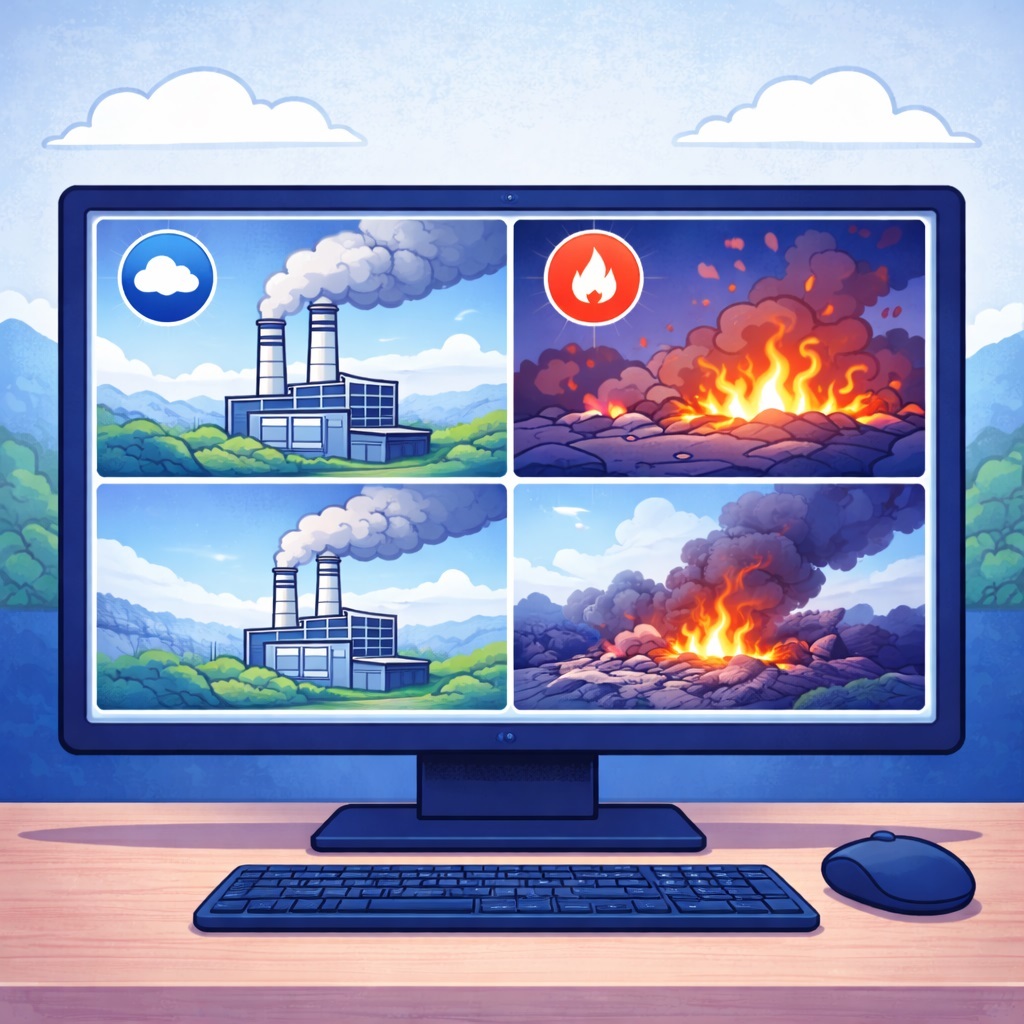
Fire safety has been built for decades on a simple and, generally, honest logic: first something starts to burn, then smoke appears, then a sensor detects it — and only after that does the system react. Does it work? Yes. Is it fast? Not always. Especially when it comes to open areas, large volumes, or zones where physical sensors are simply ineffective.
This is exactly where video surveillance stops being just about “security” and becomes an early warning tool. In SmartVision, smoke and fire detection is not a decorative checkbox in the settings, but a full-fledged neural network module that analyzes the video stream and notices visual signs of ignition when traditional detectors are still getting ready to sense something.
Why Video Detection Sees Earlier Than Sensors
A physical sensor reacts to consequences: smoke concentration, temperature rise, or the presence of gas. A camera works differently — it observes changes in the scene itself.
The result is simple and practical: the alarm is triggered not when smoke reaches the ceiling, but when it has just begun to appear. And that is the difference between a local incident and a full-scale emergency.
How It Works in Practice
The detection module is embedded directly into the video stream. Any IP camera connected via RTSP or HTTP can become a source for analysis. No additional sensors, cables, or installation work are required.
Once the feature is enabled in the camera settings, the system continuously analyzes the image.
It is important to note that smoke and fire detection is recommended to be used separately from other analytics. This reduces system load and increases recognition accuracy — the old, proven principle of “one task — one tool” still works perfectly.
Use Cases: Where Video Detection Is Truly Indispensable
Industrial Facilities and Warehouses
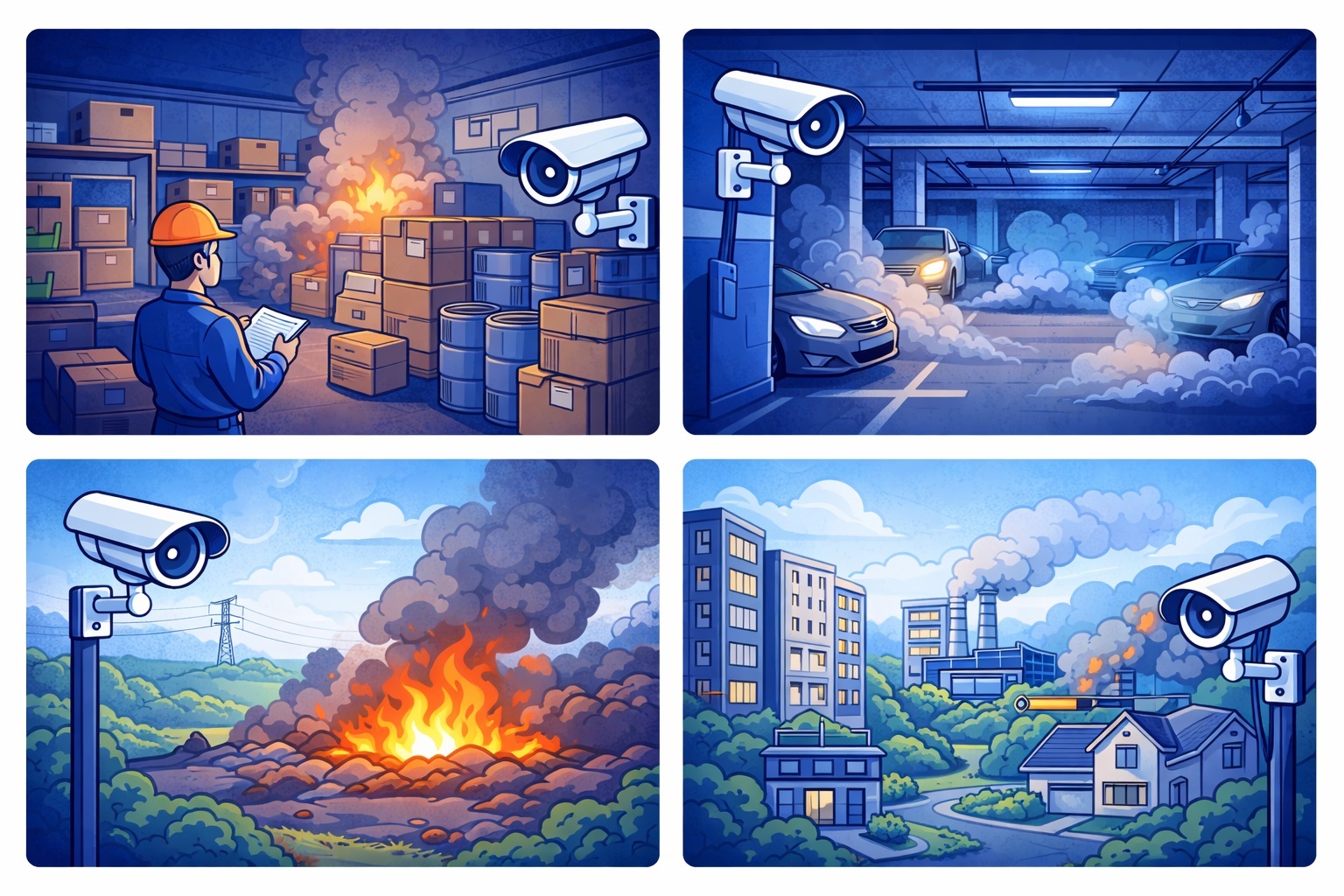
Warehouses storing packaging, raw materials, recyclables, and finished products are classic sources of hidden fires. Smoldering can last for hours without visible flames.
Underground and Outdoor Parking Facilities
Exhaust fumes, steam, headlights, reflections — a challenging environment even for an experienced operator. SmartVision’s neural network is trained to distinguish smoke from headlight beams and fog, allowing it to detect real smoke in time rather than “just another Monday in the parking garage.”
Open Areas and Outdoor Zones
Outdoors, smoke detectors are often useless: wind disperses concentrations, and humidity interferes with electronics. A camera doesn’t care where the smoke goes — it analyzes the entire scene and detects anomalies even at distances of tens of meters.
Energy and Infrastructure Facilities
Power plants, substations, and industrial sites with hot surfaces and open flames. Video detection allows monitoring areas where installing physical sensors is either impossible or economically impractical.
Residential Complexes and Private Homes
An additional layer of protection for common areas, parking lots, technical rooms, and courtyards. A camera does not replace a fire alarm system, but it often becomes the first source of an alert.
Intelligent Filtering Without Illusions
One of the main problems of any automated system is false alarms.
Dust, fog, steam, welding, sun glare — all of these have visual characteristics different from real smoke and fire. That’s why the system reacts not to a “gray spot,” but to changes in scene behavior. And unlike a human, it does not get used to things or think, “it’s always been like this.”
Ecology as a Side Effect of Good Visibility
An interesting side effect of video detection is environmental monitoring. Cameras capture the visual profile of emissions in real time: density, color, shape, and direction. This makes it possible to detect:
- unscheduled or nighttime emissions;
- changes in the nature of exhaust plumes;
- abnormal emissions where they “should not” occur.
This is not a replacement for laboratory measurements and reporting. It is their alarm clock. The system shows that something has changed here and now — not in the next reporting period.
At the same time, a single camera can perform other tasks in parallel: monitoring people in hazardous zones, equipment, movement, and compliance with regulations. One system — many tasks, without a zoo of interfaces and licenses.
The Technical Side, No Surprises
The module runs on 64-bit Windows systems, supports GPU acceleration, and is resilient to connection failures. After a camera restart or a temporary stream interruption, analysis resumes automatically. Detection can be enabled independently of other analytics blocks, simplifying scaling and configuration.
A Camera as a Fire Watch Post
The neural-network-based smoke and fire detector in SmartVision is not a replacement for traditional fire safety systems. It is an additional layer of protection that sees where sensors react too late — or do not work at all.