
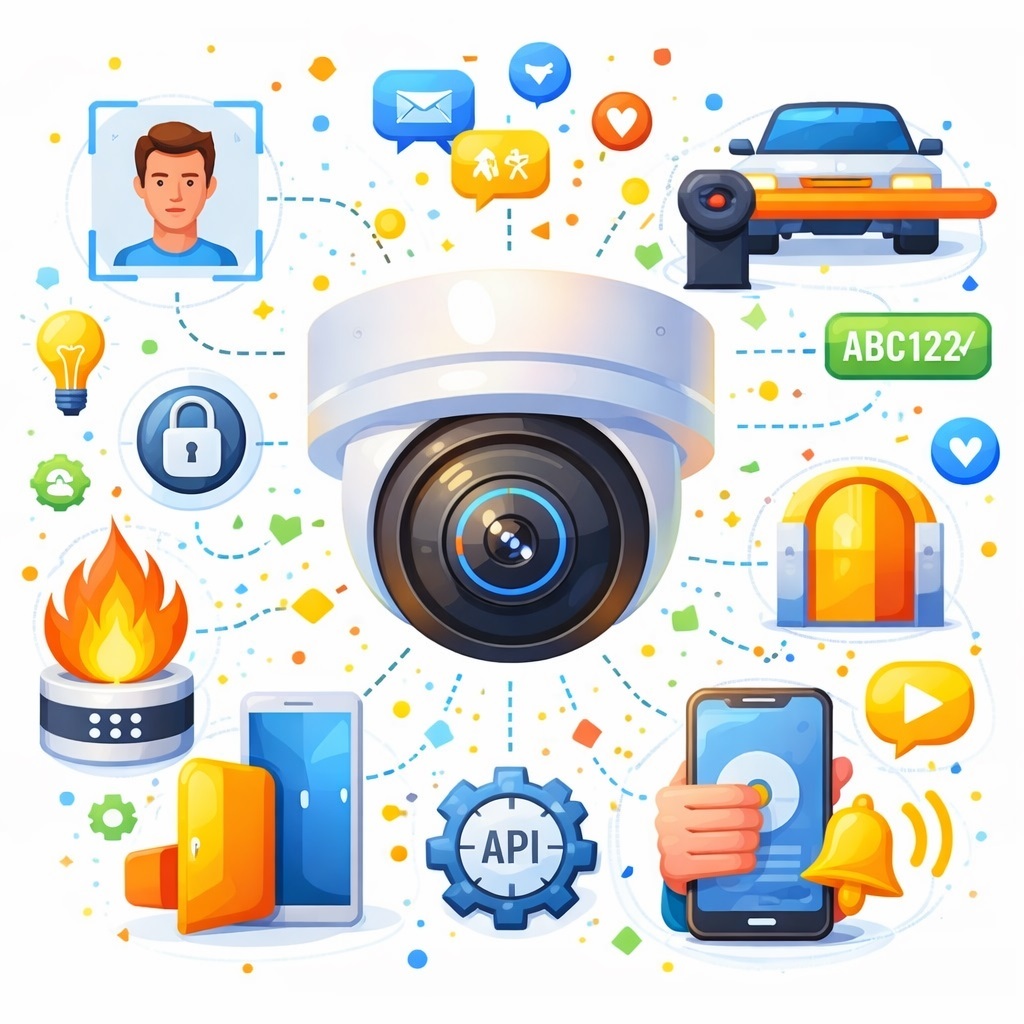
For a long time, the surveillance camera had a fairly modest job description. Hang on a wall. Stare at one spot. Stay quiet. Record. Occasionally endure rain, dust, and a bad installation day. Then, when something unpleasant happened, people would come over and ask the old question that has echoed through server rooms for decades: “Do we have the footage?”
That was the age of passive surveillance. In that world, the camera was a witness, not a participant. It did not decide anything, interfere with anything, or help much beyond the fact. It was useful, sure, but only in the same way a streetlamp is useful. It illuminates the scene, but it does not unlock the door.
That era is ending.
A modern intelligent video surveillance system no longer wants to be just an archive with a lens. It sees a face and understands that it belongs to an employee. It sees a license plate and knows it belongs to a supplier. It hears breaking glass and raises an alarm before the guard has time to finish his coffee. It notices a worker without a hard hat and does not simply save a dramatic frame for later review. It triggers a voice warning, sends a notification to the shift supervisor, and refuses access to a hazardous area.
This is the moment when a camera stops being just a camera. It becomes an event sensor. Add an integration module, and it becomes something more than that: an execution node. A part of the digital nervous system of a building, warehouse, store, campus, factory, or home.
Put simply, the future of surveillance is no longer about watching. It is about understanding and acting.
The Camera’s New Role: Not Recording, but Reacting
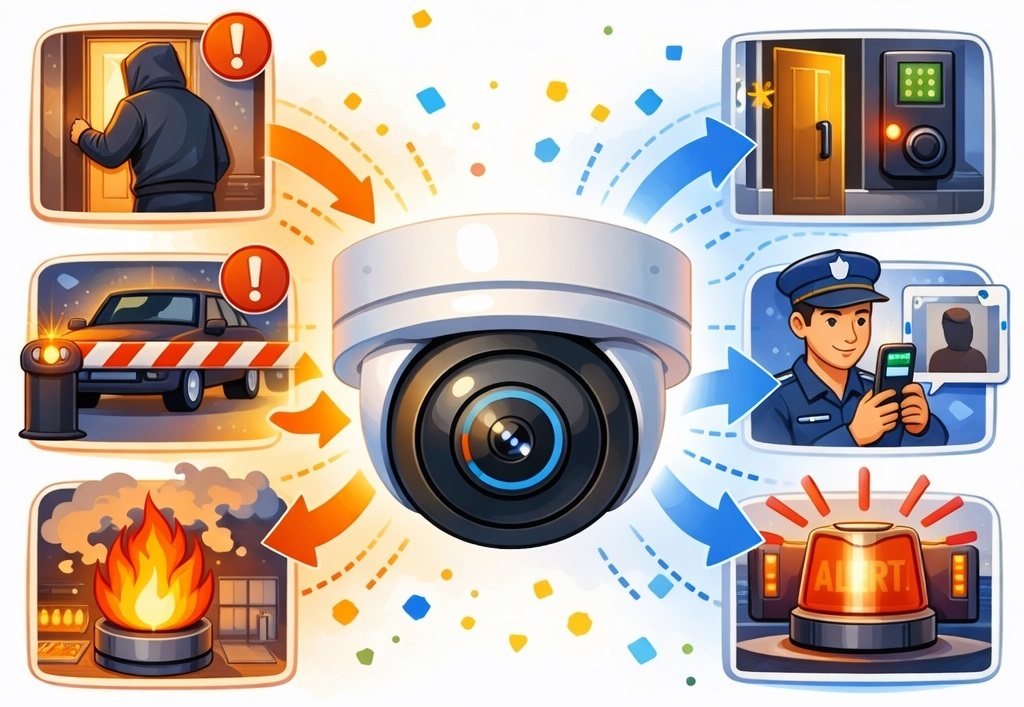
The biggest shift of the last few years is not just about neural networks. Yes, algorithms are much better now at detecting faces, plates, people, animals, fire, smoke, falls, abandoned objects, and even sound patterns. But detection alone does not make a system intelligent. What makes it intelligent is the next question: what happens after detection?
If nothing happens after a face is recognized, that is still just analytics. If face recognition opens a door, disarms a vestibule, logs the entry, and sends an event to the guard station, that is automation.
On paper, the distinction looks subtle. In practice, it is a canyon.
One system says, “I saw something.” Another says, “I understood what happened, checked the context, and launched the right scenario.” That is why the integration module is no longer a side option buried in a menu. It is becoming the central mechanism of the entire platform. It connects the camera’s vision to actions in the physical world.
The logic is simple, almost elegant: event, condition check, decision, action, logging. There is something deeply engineering-driven and strangely beautiful about that chain. The world becomes more predictable when even an alarm is structured like a clean logical sequence.
A camera recognizes an employee, the system checks the schedule, opens the door, marks attendance, and disarms the approved zone. Or the reverse: the camera spots a person near the gate at night, the face is unknown, the floodlight turns on, the owner gets a photo, the audio channel opens, and the incident recording is archived with high priority.
That is no longer a camera. It is a programmable interface between the physical world and digital logic.
Face as Key, Pass, and Trigger
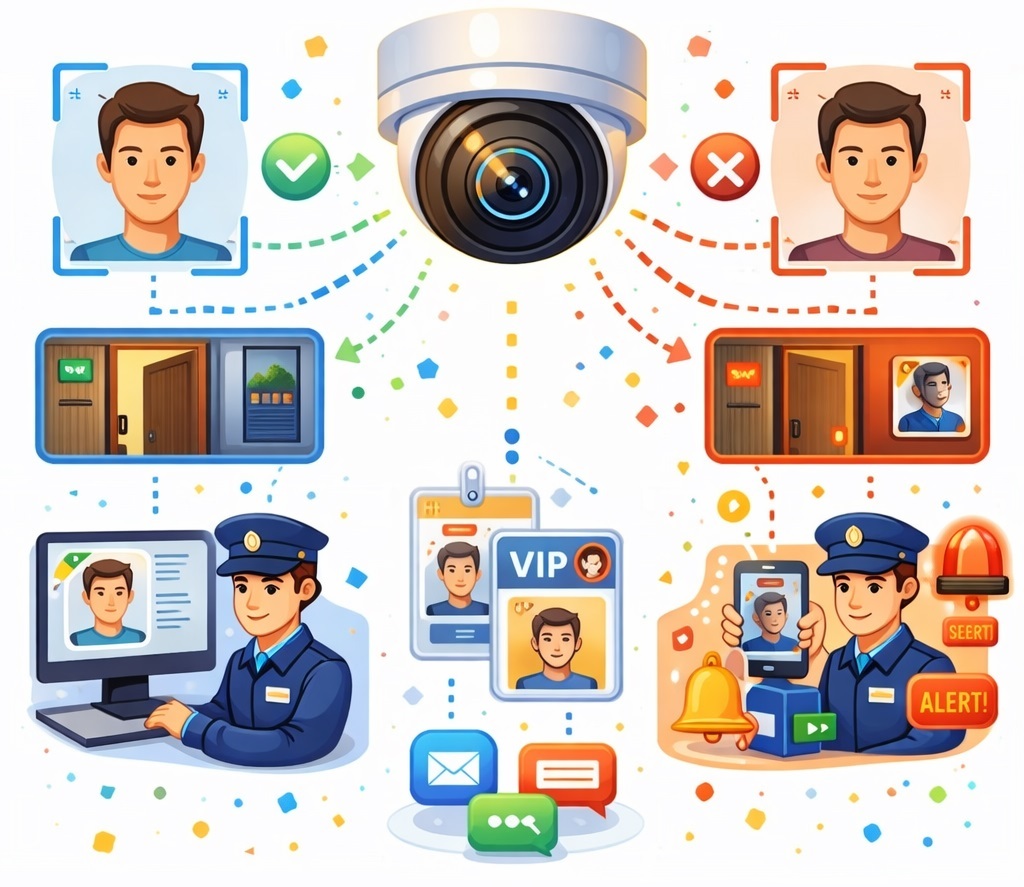
Facial recognition spent years being marketed as futuristic magic, but in mature systems it is no longer about spectacle. It is about routine made frictionless.
An employee walks up to the entrance. The system recognizes the person, checks the schedule, opens the door or turnstile, writes the event to the log, and shows the name to the operator. That is it. No heroics, no drama, just a normal workday where nobody has to dig through a jacket pocket for an access card and security does not have to guess who entered.
But the same mechanism works in reverse. If the system spots someone on a blacklist, it does not open the door. It launches an alert window, sends a push notification, Telegram message, or email, assigns a PTZ camera to track the subject, stores the best frames separately, and, if necessary, locks nearby doors. In one instant, facial recognition stops being a convenience feature and becomes a full security instrument.
Then there is the subtler layer: VIP customers, returning visitors, known contractors. For them, facial recognition triggers not an alarm and not merely access, but a service workflow. Notify the manager. Show the client card on screen. Display a welcome interface. Mark the visit in the CRM. In that context, the camera becomes part of the customer experience. It sounds like the future, but the future, as usual, is already sitting quietly on the wall, watching the front entrance.
A License Plate Is No Longer Just an Image
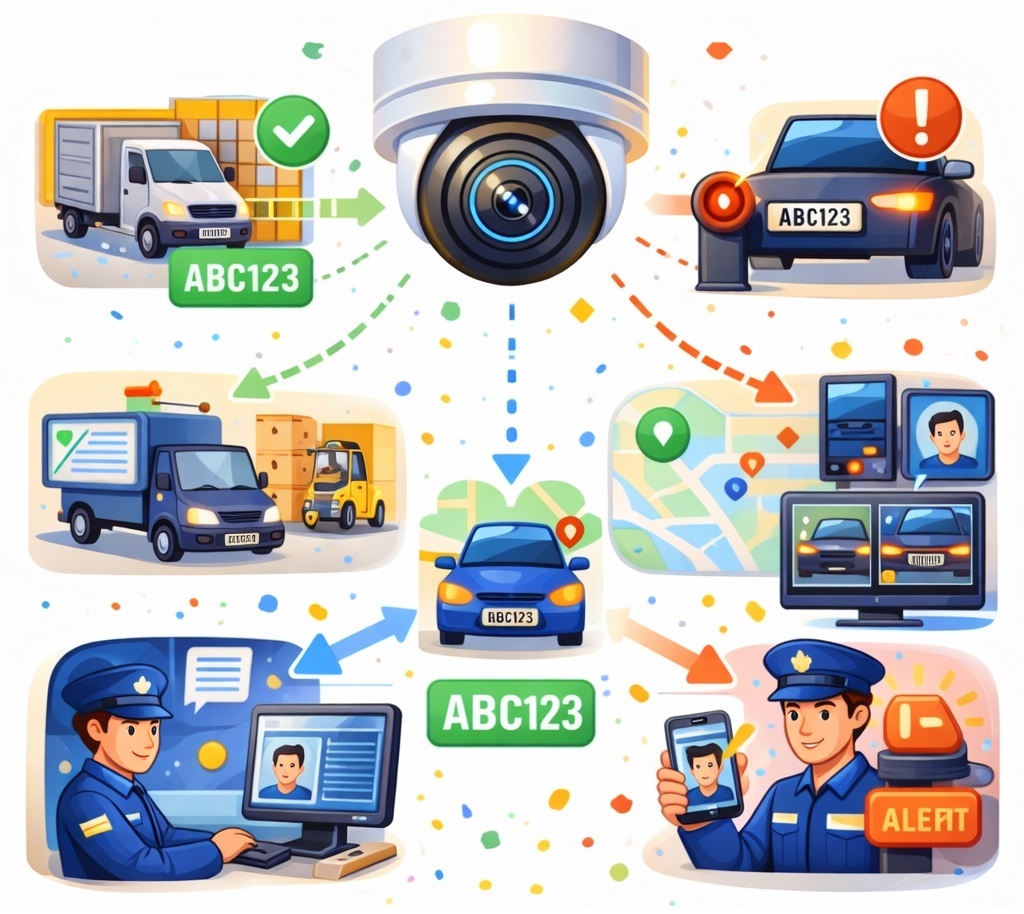
A vehicle plate has also outgrown its former life as a string of characters buried in archived footage. Once the system can compare plates against lists, evaluate context, and launch actions, entry control and parking become automated operations.
A supplier’s vehicle approaches the gate. The system reads the plate, checks the whitelist, opens the gate, notifies the warehouse, and starts an unloading timer. That is not just convenient. It is a compact logistics operating system running on top of a camera and a scenario engine.
Now flip the situation. A plate appears on a blacklist. The barrier stays closed, security receives an alert, recording starts on multiple cameras, and frames from both front and rear angles are saved. Add the vehicle’s position on a facility map, and this is no longer “video surveillance at the gate.” It is perimeter control.
The most interesting part begins when the logic becomes smarter than a simple list comparison. Take a duplicate plate. The system can detect that a vehicle with the same number is already on site. It can compare color, body type, direction of travel, and entry history. At that point, it is no longer “read the plate.” It is an attempt to determine whether a substitution is taking place.
Those details are what separate a polished demo from a system that can actually survive real-world deployment.
Fire, Smoke, and the Moment Automation Must Be Faster Than Humans
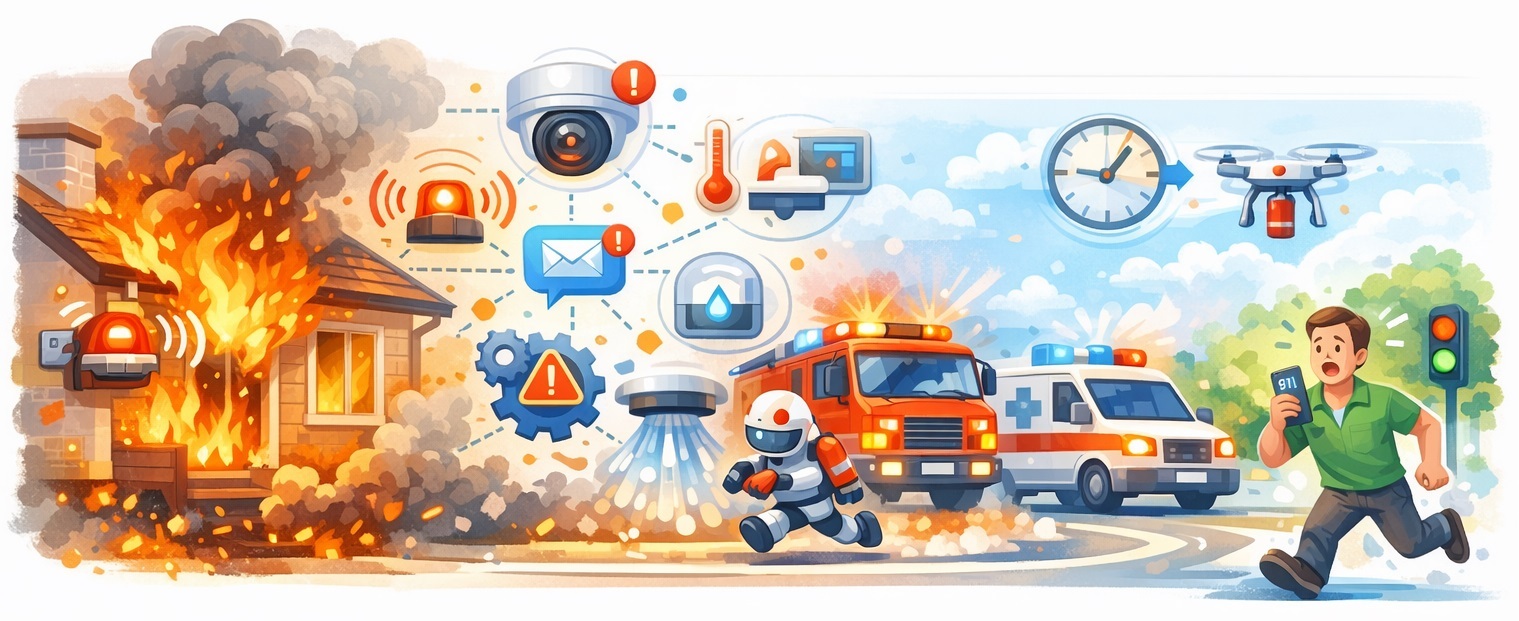
Fire scenarios may be the clearest argument for why integration matters at all. In events like these, delay is expensive, but the wrong sequence of actions can be just as costly.
If a camera detects fire, the next step should not be a pause that says, “The operator will check it in a moment.” The next step should be a prebuilt logic chain: cut power to outlets or a line through a relay, trigger a siren, activate voice evacuation, alert responsible personnel, unlock emergency exits, turn on emergency lighting, manage ventilation, and, where integration permits, transmit footage to an external monitoring desk.
Smoke requires even more nuance. It is an earlier stage, which means speed and precision matter even more. Increase recording priority. Send a photo and a short video clip. Trigger the right engineering workflow. Display the event to all operators. The system must not merely confirm that something happened. It must assemble the correct response package without turning the entire building into a panic show for no reason.
Equipment overheating adds yet another layer. In server rooms, switchboards, and production zones, a camera can act as an early engineering control point. Shut down rack power. Enable backup cooling. Notify an engineer. Create a service desk ticket. When surveillance starts protecting infrastructure from heat rather than intruders, it becomes obvious that the industry left the boundaries of traditional security a long time ago.
Motion No Longer Means False Alarm
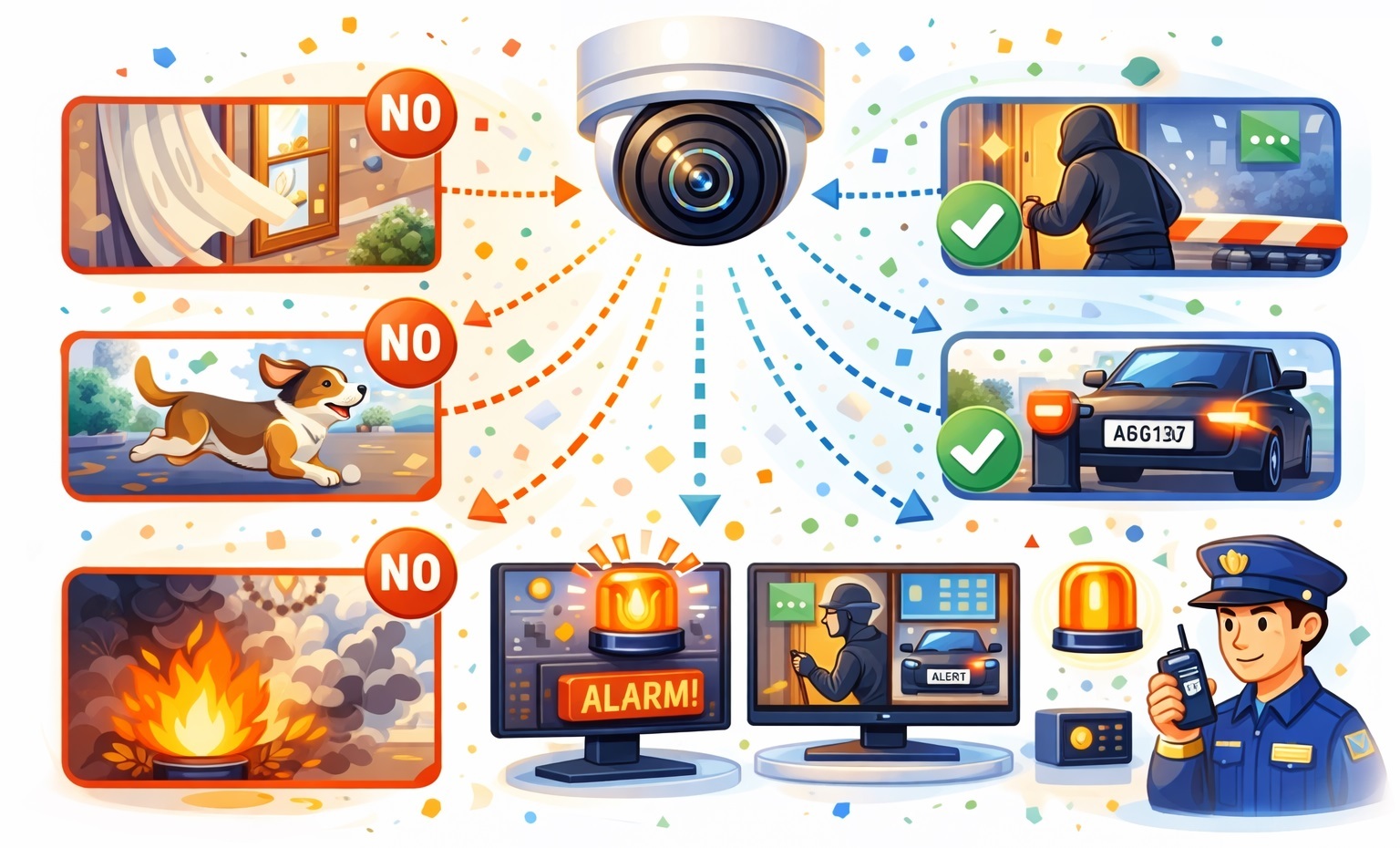
Old-school motion detection damaged its reputation back in the days when a leaf in the wind could ruin an operator’s night. Since then, it has often been treated as useful but temperamental. In modern systems, the problem is not motion detection itself. The problem is whether it is used stupidly or intelligently.
If nighttime motion in a protected zone automatically turns on a floodlight, sends a PTZ camera to a preset, starts recording, activates neighboring cameras, and pushes a notification, that is already a solid scenario. If motion near a safe or cash register stores video from both before and after the event using buffered footage, that is a valuable investigative tool. If motion in a restricted area triggers an alarm and displays the facility map with the activation point for the operator, that is a competent security interface.
The point is not to react to every pixel twitch. The point is to connect motion to context: time, zone, object type, direction, dwell time, and confirmation from other signals. Then the system stops getting nervous over every shadow and starts behaving like an adult rather than a highly impressionable intern.
Person, Animal, Queue, Fall: Neural Networks Step Into the Real World
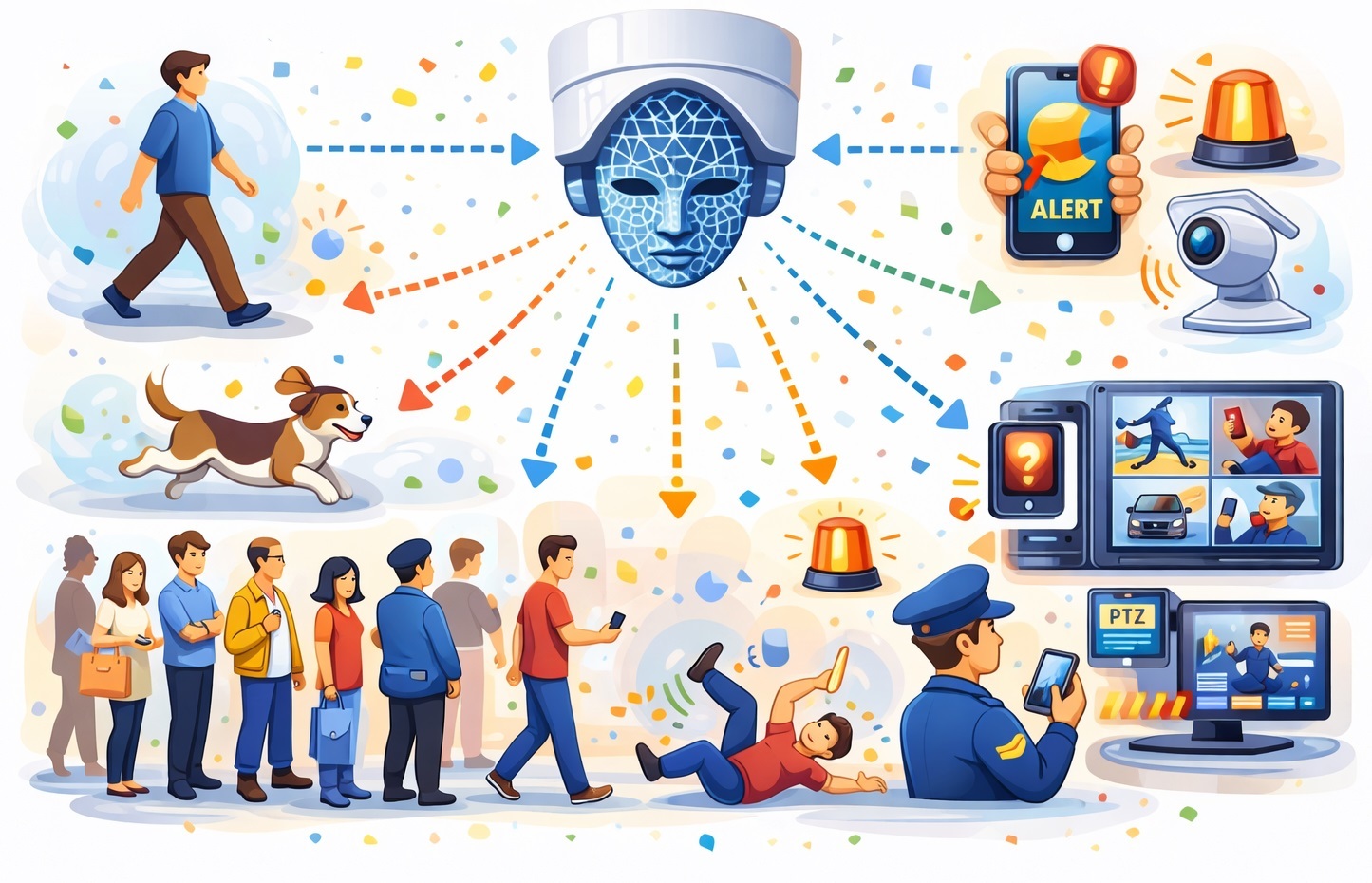
As soon as the system begins to distinguish not just motion but object type, scenario architecture becomes more complex and, at the same time, much more useful.
A person in a hazardous industrial zone calls for one response. A person in an evacuation route, another. A person near the perimeter, a third. A fall event, a fourth. A long period without movement, a fifth. Crowd accumulation, a sixth. Running, fighting, or suspicious behavior near a door or ATM, a seventh. Same object class, completely different consequences.
In retail, this means queues, footfall density, shelf activity, empty shelves, and conversion from entries to purchases. In healthcare, it means patient falls and unauthorized exits from rooms. In industrial settings, it means a worker without a helmet, without a vest, using a phone in a dangerous area, or smoking in a place where that should not even be a creative thought. In residential settings, it means a familiar face at the door, a courier, a child returning home, or an elderly resident who has not appeared in view for too long.
One of the more elegant scenario classes involves animals. Any mature system should know not only when to raise an alarm, but when not to. If a dog appears on the property at night, there is no need to trigger a full siren as if the perimeter has been breached by a small furry commando unit. It is better to label the event as “animal,” filter out the false alarm, and not turn the neighborhood into a one-dog theater. A small detail, perhaps, but systems become truly livable through details like that.
Sound: The Underrated Security Channel
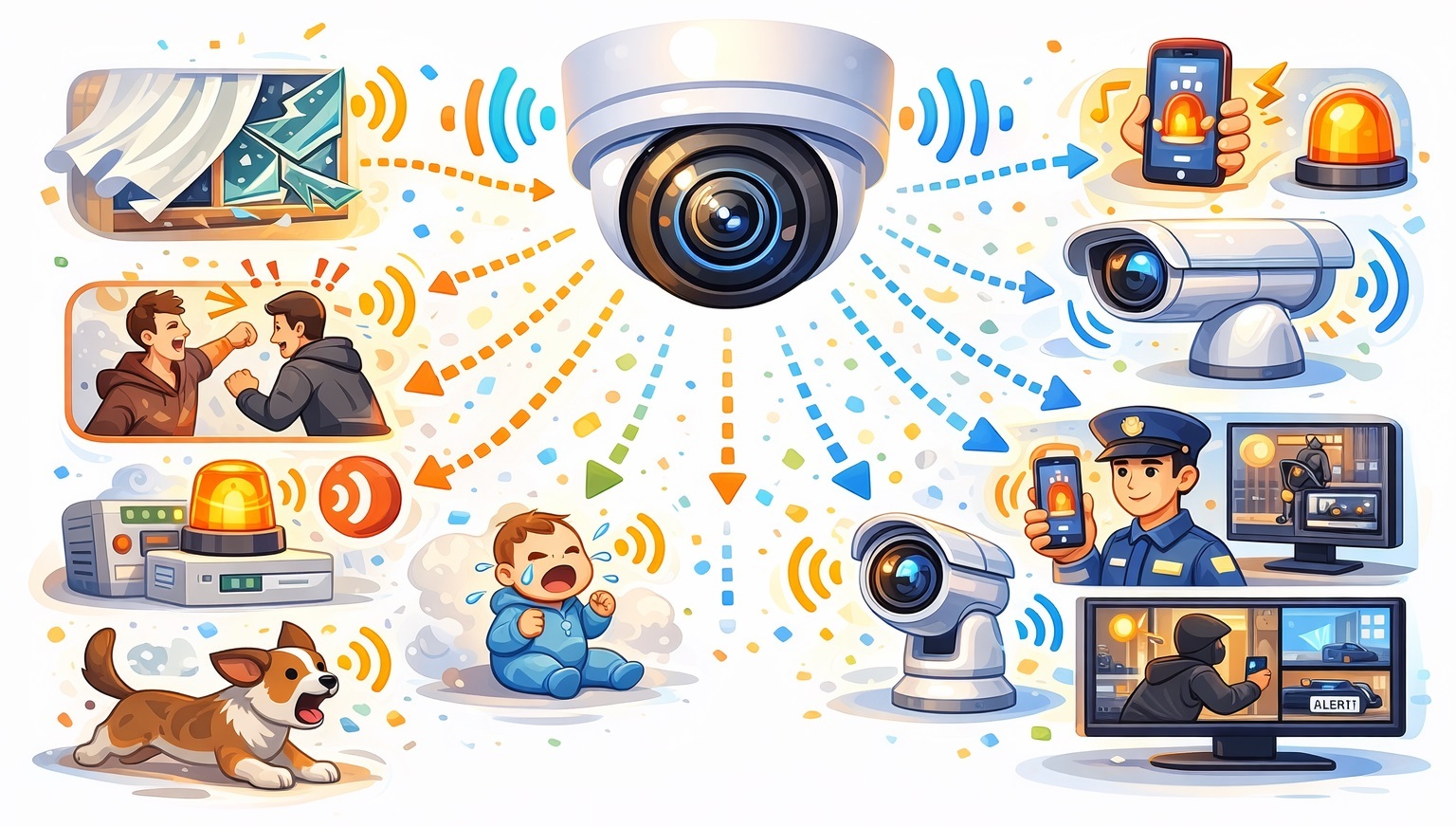
Most conversations about video analytics revolve around imagery, even though the real world often makes noise before it becomes visible as a problem.
Breaking glass, screaming, the sound of a fight, a gunshot, an equipment siren, a baby crying, a dog barking. These are not merely audio events. They are a separate layer of early detection, one that is often faster than visual analysis. The camera may not yet see enough detail, but it can already hear a dangerous pattern and trigger the correct response.
The sound of shattered glass launches an alarm, floodlight, and PTZ response. A scream or fight noise activates two-way audio and alerts a security team. A gunshot pushes the system into maximum-priority mode, locks down access routes according to policy, and escalates recording across the sector. Meanwhile, the sound of failing equipment may not interest security much at all, but it will interest an engineer, and the system can create a service ticket automatically.
Against that backdrop, it becomes obvious that a camera with a microphone is no longer just a recording device. It is an acoustic sensor embedded in a decision-making architecture.
API: Where the Magic Becomes Engineering
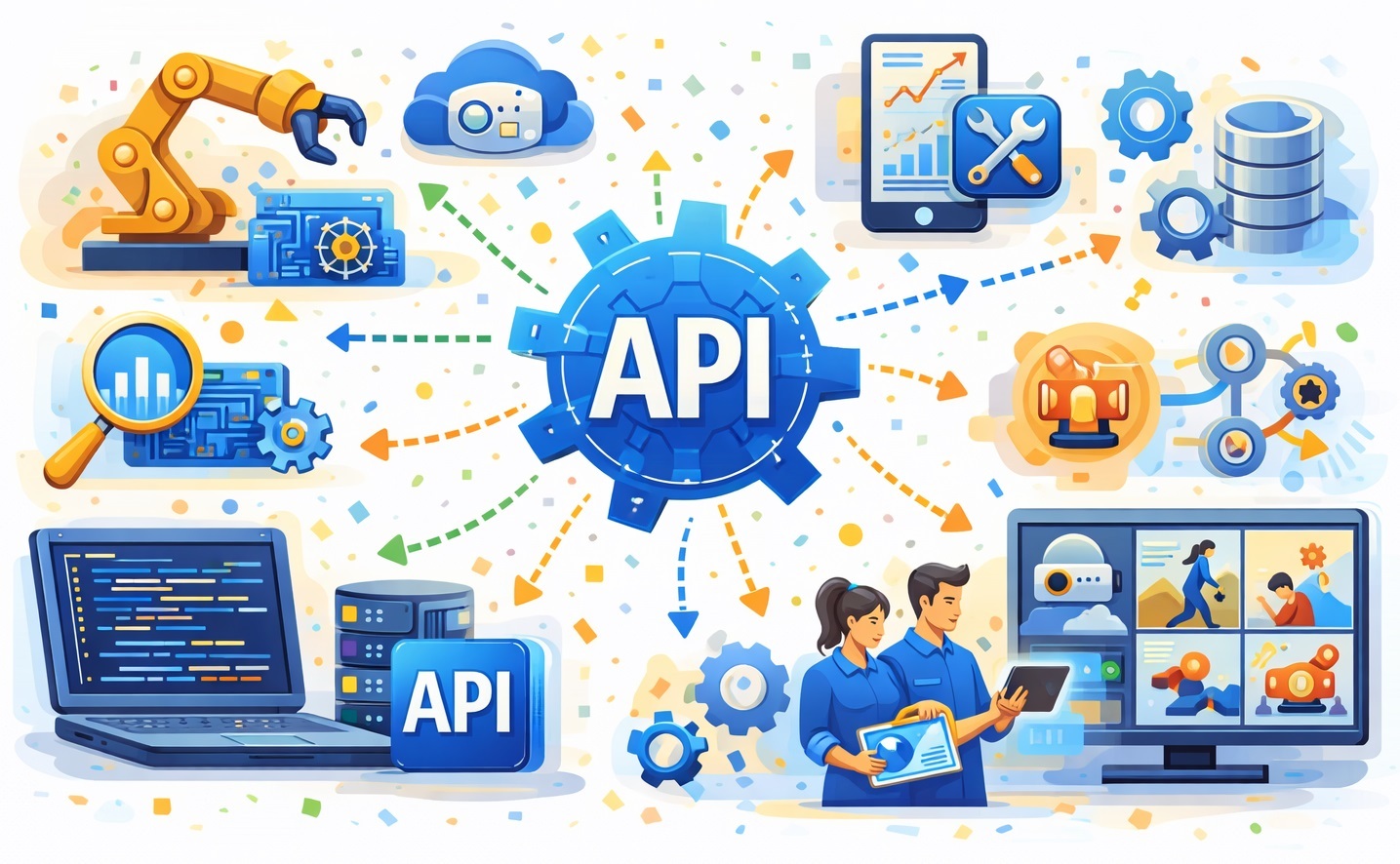
Every “smart” system stops being smart the second it cannot be integrated. No matter how polished the presentation deck may be, without an API the whole thing ends in manual button presses and hope that the operator does not miss something.
That is why the true center of a modern surveillance platform is not only the neural network, but the event engine backed by a serious API. Not a decorative one. Not a token pair of endpoints tossed in “just in case.” A real API on which automation can be built.
Architecturally, it is refreshingly sober. A camera or analytics module produces a normalized event: detection type, camera, zone, timestamp, confidence, snapshot, clip, priority, metadata. Then the rules engine checks conditions. Is it night? Is this business hours? Is the target on a whitelist? Has the event been confirmed across multiple frames or cameras? Is there a weather anomaly? Is this an employee? Has the same event already repeated three times in the last five minutes?
Once that logic is resolved, the action starts. Webhook. HTTP API. MQTT. Modbus. Access control command. Database record. CRM message. Ticket creation. Relay activation. PTZ movement. Lock release. It no longer looks like science fiction. It looks like disciplined engineering work, just built on top of video.
Feedback matters, too. If the door did not open, the system should know. If an external service failed to respond, it should retry, log the failure, and notify the operator. Automation without result verification quickly turns into digital theater. Attractive, perhaps. Useful, not so much.
A Good Scenario Does Not Just React. It Thinks.
The greatest temptation in automation design is to reduce everything to a rule that says, “If detected, then perform action.” That is how bad systems are born. They look impressive for two days and then begin annoying everyone around them.
A good scenario is selective. It triggers only at night. Or only in a defined zone. Or only if the object remains in frame for more than N seconds. Or only if person, motion, and sound are confirmed together. Or only if it is not an employee. Or if the event has repeated three times in ten minutes and each time with higher confidence. Or if two cameras reported it simultaneously.
That is the real power of a scenario engine. Not the number of checkboxes, and not the length of the brochure, but the ability not to fuss. A system should be strict without being nervous. Attentive without being hysterical. On a good site, that is what people value most.
From Store to Factory: One Platform, Different Dialects
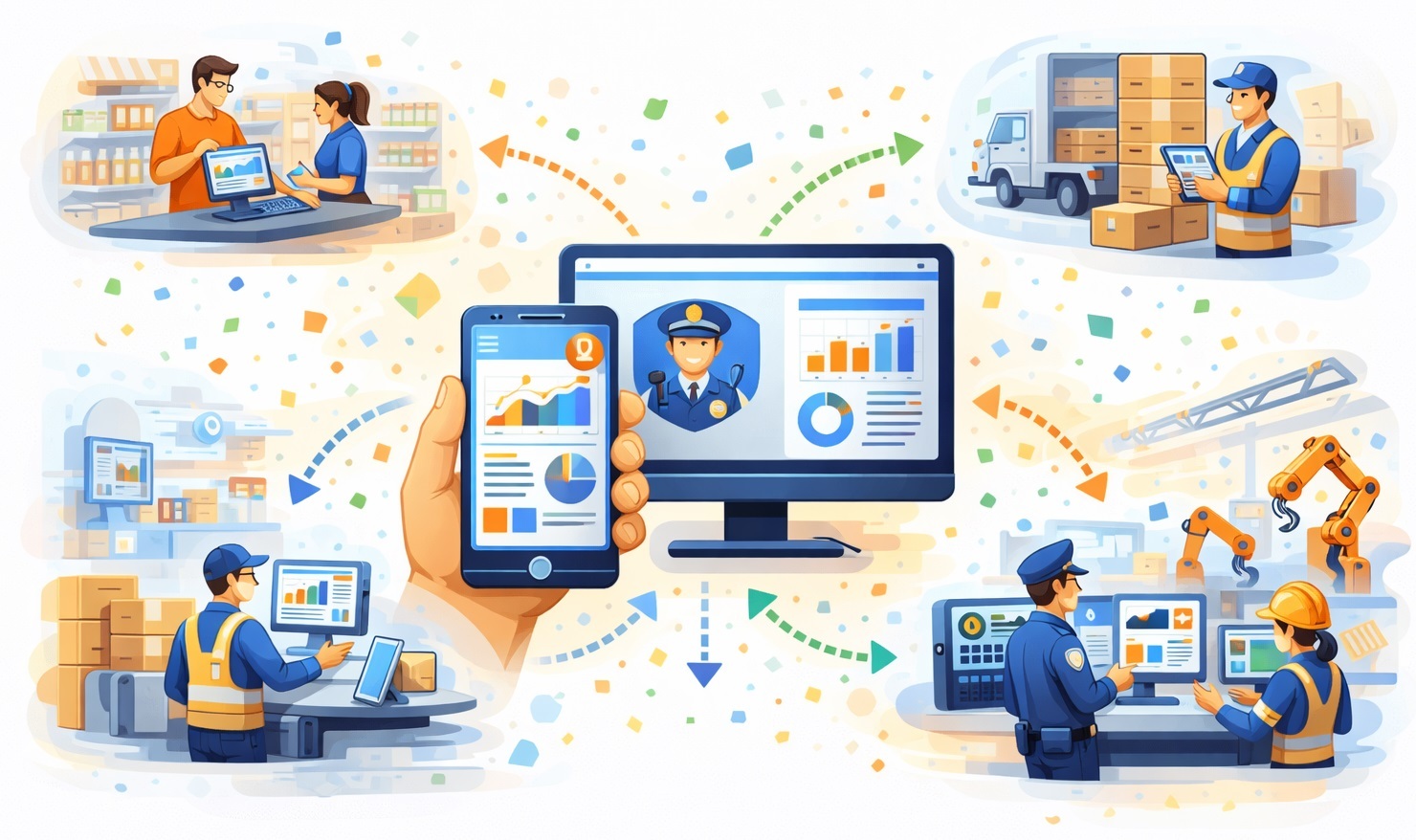
What makes intelligent surveillance especially compelling is that the same technological platform speaks a different language depending on the industry.
In retail, it speaks in the language of queues, shelves, foot traffic, and conversion. In warehouses, it speaks in the language of unloading, pallets, forklifts, and WMS. In manufacturing, it speaks in the language of helmets, safety vests, machines, and hazardous zones. In homes, it speaks in the language of intercoms, gates, couriers, and the quiet reassurance of “someone familiar has arrived.” In hospitals, it speaks in the language of patient falls, staff escorting, and urgent calls for assistance.
The camera itself does not change. What changes is the scenario logic built around it. That is what makes modern surveillance feel less like a scattered collection of features and more like a universal automation platform that can be adapted to almost any environment.
The Interface Has to Grow Up Too
There is one thing that breaks even good systems: the event interface. As long as events are rare, any list looks decent. But the moment analytics starts working at scale, events become a stream. Then the old familiar form that loads everything at once starts behaving like a cabinet someone tried to stuff with an entire archive and no folders.
A proper system needs pagination, lazy loading, list virtualization, careful preview and clip handling, memory optimization, and leak control. These are not “technical details.” They determine whether an operator can actually use the platform without feeling that the interface is fighting back over every click.
The same logic applies to manual deletion tools for old media and records over a selected period on a chosen camera. Not some vague cleanup promise for later, but a practical, explicit workflow: camera list, record count, period selection, deletion of media and linked database entries, confirmation, logging. These features almost never make it onto a marketing banner. They are also exactly what make a system feel mature.
The surveillance industry is exceptionally good at creating data. It is far less enthusiastic about helping people remove it.
What Comes Next
Next, cameras will become even less like cameras in the old sense. They will embed themselves deeper into the processes of buildings, enterprises, and cities. Not as isolated devices hanging on walls, but as components of a distributed digital environment where video, audio, analytics, APIs, and actuation mechanisms operate within one shared logic.
The winners will not be the systems that detect the largest number of objects. The winners will be the systems that understand context more accurately, filter false scenarios more intelligently, integrate with external systems more reliably, and translate events into actions more gracefully.
Because the value of video today is no longer in being able to look back later and see what happened. The value lies in making sure the right response begins at the moment when the outcome can still be changed.
The camera that merely records an archive is not going anywhere. But next to this new architecture, it starts to look like a push-button phone beside a smartphone. Yes, it can still make the call. But the world has already moved to a slightly different rhythm.