
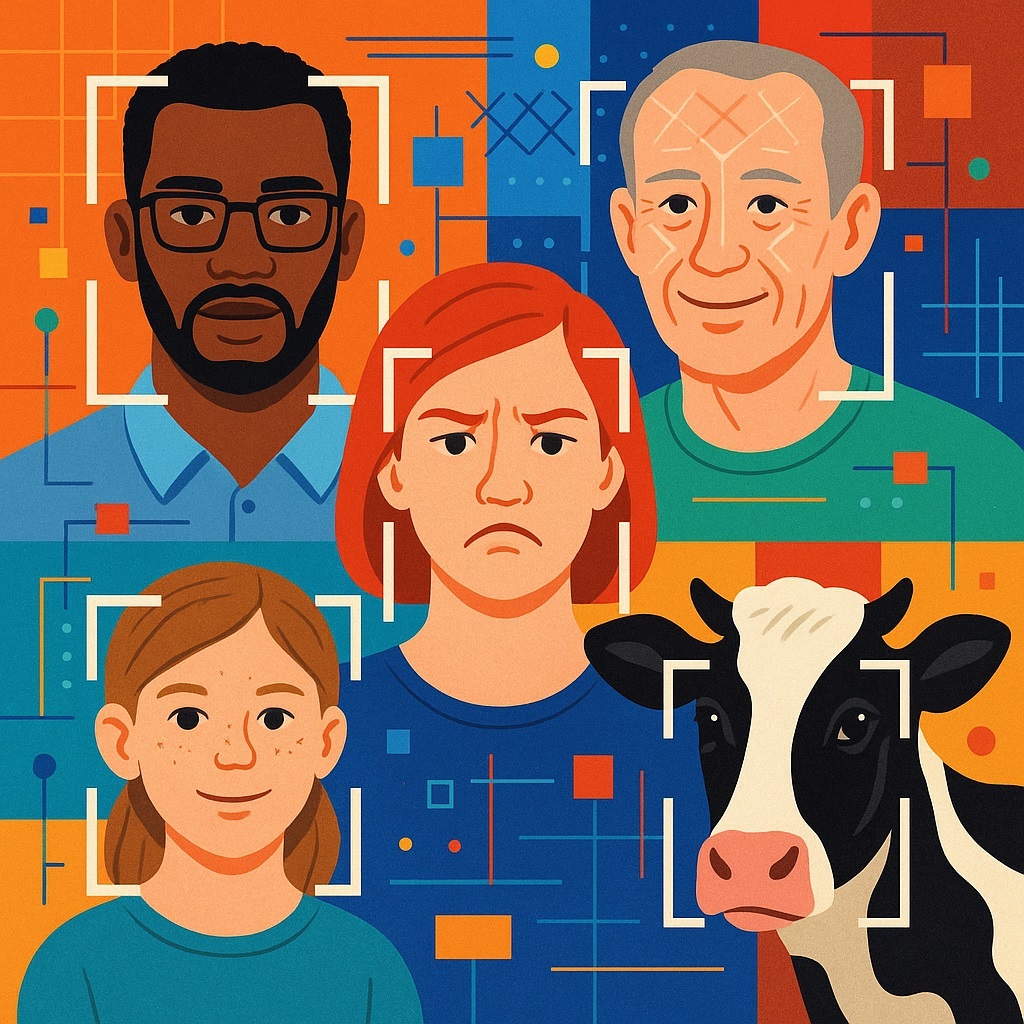
Twenty years ago, the word biometrics sounded as exotic as “nanobots” or “home DNA sequencers.” It was a niche topic reserved for passport-equipment manufacturers, a handful of tech startups, and futurists who insisted that by 2025 we’d be crossing borders via “thought signatures.”
The rest of the world carried on blissfully unaware that cameras would soon learn to see too much — age, emotions, gait, clothing, hairstyle, hair color, glasses, tattoos, and sometimes things a person would rather hide from everyone, including themselves.
Technology today is racing to predict who we are and how we feel. The law, on the other hand, is desperately trying to hold the line — and every country draws that line differently. A single surveillance system can be harmless “video analytics” in Moscow, a dangerous AI intrusion in Brussels, grounds for a multimillion-dollar lawsuit in Illinois, and just an “enhanced CCTV camera” somewhere in Singapore.
At the center of all this chaos sits an almost innocent word: biometrics.
It sounds futuristic, but legally it means something surprisingly mundane: information about a person that can be used to uniquely identify them, and is actually used for that purpose.
Simple in theory. In practice? A philosophical minefield.
Is emotion detection biometrics? What about age estimation? Hair color? Clothing? Gender? Behavioral patterns? Face similarity scoring without naming the person? And what happens when algorithms quietly try to infer racial or ethnic background — something no one wants them to do, but something machine-learning models often attempt because it simplifies clustering?
Every country answers these questions differently — sometimes dramatically so.
Europe: A Legal Labyrinth Where Even Emotion Recognition Is Almost a Crime
In Europe, biometrics is a sort of digital sacred category. Under GDPR, a face is not biometric data by default. It only becomes biometrics when it is processed for the purpose of unique identification.
But the real trouble began when technology started digging deeper: into emotions, micro-expressions, behavioral signals, stress levels, and even attempts to guess personality traits. Suddenly the classic definitions crumbled.
The new AI Act, entering force in 2025, treats emotion recognition as a high-risk technology. It’s not biometrics, but it’s also not “ordinary analytics.” It’s something closer to a psychological polygraph — and in schools or workplaces, it’s effectively banned.
Europe believes emotion-tracking tools break the fundamental balance of power between individuals and institutions.
Then there’s the explosive topic of race detection.
GDPR draws a hard line: racial or ethnic data is always highly sensitive. Even the attempt of an algorithm to infer race from an image is considered discriminatory by default.
The irony? Many commercial models still try to guess race internally because it simplifies their classification pipelines. European regulators see this as a ticking legal time bomb.
The United States: A Legal Roulette Where the Prize Is “Not Being Sued”
If Europe is a cathedral of regulation, America is a patchwork frontier.
There is no federal biometric law. Each state cooks up its own rulebook.
Standing above them all is the legendary Biometric Information Privacy Act (BIPA) of Illinois — a law that turned biometrics into the most expensive category of data on Earth.
Under BIPA, nearly everything counts as biometrics:
- face templates,
- comparisons,
- scans,
- pattern analysis,
- behavioral identifiers.
Facebook, Google, Snapchat, and hundreds of smaller companies have paid massive settlements — and usually lost.
But cross the state line, and all that might be perfectly legal.
The result is a jurisprudential roulette wheel:
- prohibited in Illinois,
- restricted in Texas,
- mostly allowed in California,
- ignored entirely in many other states.
For companies, it’s like walking through a field of invisible tripwires.
China: Where the Face Is Always Sensitive Information
China, unsurprisingly, chooses clarity over nuance. Here, the face is always sensitive personal data.
Emotions? Sensitive.
Behavior? Sensitive.
Gait analysis? Sensitive.
Age estimation? Sensitive.
Commercial use of these technologies is allowed only under strict supervision. Any attempt to deploy emotion recognition or behavioral scoring without clear consent is a direct violation.
If Europe fears manipulation, and America fears lawsuits, China fears one thing above all: uncontrolled information about its citizens.
Russia: Pragmatism With an Identification-Based Logic
Next to all this, Russia’s approach looks almost refreshingly straightforward. The law doesn’t try to turn every pixel into biometrics.
The rule is simple: If the system does not identify a person — it is not biometrics.
In Russia, the following are not biometrics:
- emotions
- age
- hair color
- beard
- glasses
- clothing
- gait (unless used specifically for identification)
- gender estimation
- any analytics that do not attempt to establish identity
Even “similar face search” is not biometrics until the system explicitly says, “This is Ivanov.”
The key legal criterion is intent.
If a camera says: The person is smiling” — that’s analytics.
If it says: “Ivanov is smiling” — that’s biometrics.
This creates a wide space for anonymous video analytics while keeping strict rules for actual identity recognition.
Meanwhile in Agriculture: Biometrics Without Humans
One of the more amusing arenas of computer vision is modern agriculture, where “facial recognition” is thriving among… cows, pigs, chickens, and horses.
AI systems today can:
- identify individual cows by their muzzles,
- track the health of pigs,
- monitor poultry behavior,
- detect stress in horses.
But animals are not legal subjects in any country, so none of this is considered biometrics.
The only real compliance risk is accidentally identifying the farmer standing next to the cow.
The Forbidden Art: Race Estimation
Race estimation deserves special attention because it’s the most politically radioactive capability of modern AI.
- Europe treats any racial inference as inherently illegal.
- The U.S. allows it, but it’s almost guaranteed to trigger massive liability.
- China treats it as highly sensitive data requiring maximum oversight.
- Russia doesn’t classify racial or ethnic appearance as biometrics unless it becomes part of identifying a person.
The twist is that many AI systems still infer race internally even if the feature is never exposed — because it makes their classification models more efficient. Regulators worldwide consider this a serious, emerging risk.
There Is No Single World of Biometrics
The global landscape is a patchwork of fears and philosophies:
- Europe fears manipulation.
- America fears class-action lawsuits.
- China fears unregulated information.
- Russia fears unintended identification.
The same camera behaves like a different legal creature depending on which country it hangs in.
Strip away the legal definitions, and only one question remains — the real one: Where is the boundary between watching someone and having power over them?
Today it’s drawn by lawmakers. Tomorrow — by engineers. One day — possibly by the algorithms themselves.
As cameras learn to see more than we ever expected them to, societies must decide how much of that digital sight we are willing to grant — and how much must remain off-limits, not for the machine’s sake, but for our own.