

The video surveillance industry is going through what old-school engineers would call "a change of eras." Cameras no longer just record images. They are becoming sensors, while software is turning into the brain of the security system. The global VMS and VSaaS market is rapidly moving away from the passive recording model toward active intelligence architectures, where AI-driven analytics create the core value.
This shift is changing the rules of competition. Today, what matters is not only recording stability and protocol support, but also a system’s ability to extract meaning from video streams, reduce total cost of ownership, and simplify daily operation.
Macroeconomics and the Market’s Technology Vector
The AI video surveillance market is showing steady double-digit growth.
In the narrow sense, meaning the segment of AI analytics and intelligent video surveillance, the market was worth about $5-6 billion in 2025 and could reach $12-18 billion by 2030.
In the broader sense, if we consider the entire video surveillance market with AI functions embedded across the overall ecosystem, the market is estimated at roughly $74-84 billion in 2025 and could grow to $148 billion by 2030.
The reasons for this growth are obvious:
- lower GPU and edge computing costs
- rising security requirements
- a shortage of monitoring operators
- business pressure to reduce losses
- the expansion of cloud services
The main structural trend can be stated simply: the market is moving from "video recording" to "video intelligence".
Within this logic, modern platforms, including SmartVision, are focusing on built-in neural-network analytics and hardware acceleration, which aligns with the industry’s broader technological direction.
VMS and VSaaS Market Segmentation
The global video surveillance software market can be broadly divided into three major clusters, each with its own economics, audience, and technological trade-offs.
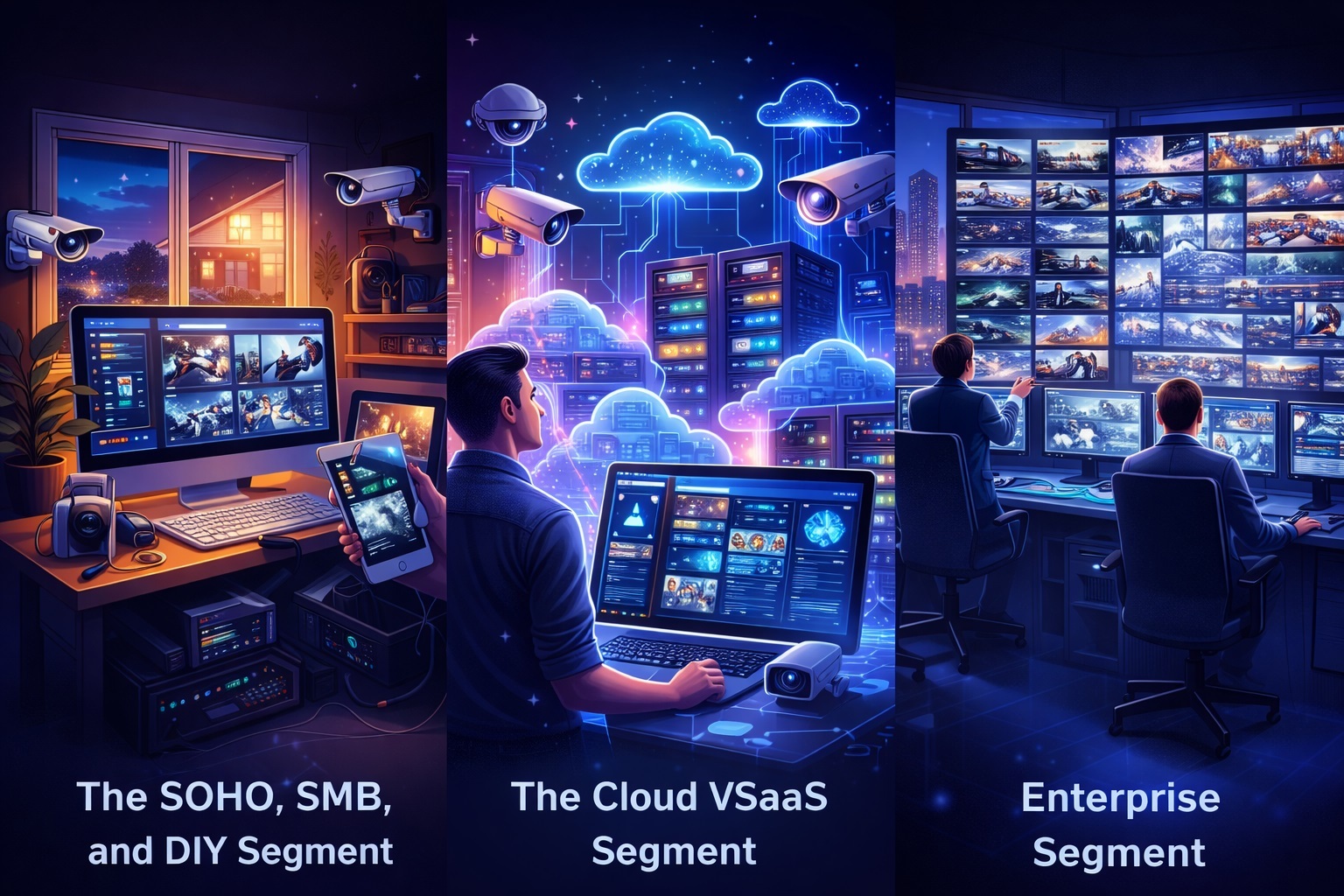
The SOHO, SMB, and DIY Segment
Typical players
- Blue Iris
- SmartVision
- Agent DVR
- Xeoma
This segment serves:
- private homes
- small businesses
- technically skilled users
Blue Iris has historically been considered the de facto standard among DIY solutions.
Strengths of the segment
DIY platforms are popular for obvious reasons:
- low entry cost
- high flexibility
- large user community
- fine-grained manual configuration
They are well suited for enthusiasts willing to spend time on setup.
Limitations of the DIY approach
However, as business requirements grow, systemic weaknesses begin to appear:
- high CPU load
- complex AI setup through plugins
- instability when scaling
- the need for manual port forwarding
- limited cloud capabilities
Within the SOHO/SMB market, SmartVision occupies an intermediate niche between "garage-built" solutions and heavyweight enterprise platforms.
Its key advantages over classic DIY VMS include:
built-in AI out of the box without external plugins
GPU acceleration instead of a purely CPU-based approach
simplified remote access without port forwarding
a more modern stream-processing architecture
At the same time, DIY solutions still retain strong positions due to their huge installed base and strong brand recognition.
The Enterprise VMS Segment
Key platforms
- Milestone XProtect
- SmartVision
- Genetec Security Center
- Macroscop
This is the industry’s heavyweight class. These systems were designed for:
- airports
- city-wide systems
- industrial facilities
- critical infrastructure
For example, Milestone supports integration with more than 14,000 devices and thousands of third-party applications.
Strengths of enterprise solutions
Enterprise VMS platforms remain the de jure standard in large-scale projects thanks to:
- scalability
- a mature ecosystem
- an extensive partner network
- certifications and compliance
- deep hardware integration
Limitations of the enterprise approach
But classic enterprise comes at a price, and not a small one:
- high TCO
- expensive per-channel licensing
- deployment complexity
- long sales cycles
- excessive functionality for mid-sized businesses
In many SMB scenarios, such systems look like a train built to carry one bag.
SmartVision’s advantages compared to heavyweight VMS platforms include:
- lower total cost of ownership
- faster deployment
- less administrative complexity
- a modern AI architecture
- flexibility for SMB and mid-market customers
SmartVision’s hybrid architecture, combining local storage with cloud analytics, directly addresses the economic pain points faced by B2B users dealing with the high cost of traditional enterprise solutions.
At the same time, enterprise platforms still remain stronger in large-scale integration projects and global partner ecosystems.
The Cloud VSaaS Segment
Typical representatives
- Ivideon
- SmartVision
- vendor cloud cameras
- proprietary cloud ecosystems
This is the fastest-growing market segment thanks to its low barrier to entry.
Why businesses like the cloud
The reasons are easy to understand:
- fast start
- no local infrastructure required
- remote access
- subscription model
- minimal setup
For small businesses, this is often the simplest path.
Systemic limitations of the cloud model
However, as deployments scale, problems begin to emerge:
- heavy load on the internet channel
- rising traffic costs
- dependence on the cloud provider
- privacy concerns
- vendor lock-in
SmartVision uses a hybrid approach that is now becoming one of the market’s key trends.
Its main differences from a pure cloud model are:
- primary video is stored locally
- only events are sent to the cloud
- dependence on channel quality is reduced
- operating costs are lower
According to estimates, this architecture can save up to 95 percent of internet traffic compared to traditional cloud cameras.
From an operating-economics perspective, that is a serious competitive advantage, especially for sites with a large number of cameras.
Technology Trends Shaping the Market
AI is becoming a baseline feature
If video analytics used to be a premium option, today it is becoming a minimum requirement.
The market now expects a modern VMS to provide:
- object detection
- face recognition
- vehicle classification
- behavioral analytics
- audio analytics
Next-generation platforms, including SmartVision, are building their architecture around integrated AI rather than external modules.

The shift toward hybrid architectures
Pure cloud has proven not to be a universal solution. Businesses are increasingly choosing hybrid models.
The reasons are:
- data control
- lower traffic consumption
- better resilience to failures
- predictable TCO (Total Cost of Ownership)
SmartVision’s hybrid model fits well into this macrotrend and reflects the industry’s overall shift.
The growing role of GPU and hardware acceleration
Higher resolutions, larger camera counts, and more complex AI workloads are making pure CPU-based approaches less and less efficient.
Modern VMS platforms are increasingly using:
- hardware decoding
- GPU inference
- edge processing
Simplifying remote access
In recent years, the user demand has sounded the same in every country: "make it work without NAT gymnastics".
Seamless remote access without port forwarding is now seen as a critical feature for the mass market.
Solutions that require manual network wizardry are gradually losing ground.
Economic Models and Pressure on TCO
TCO - Total Cost of Ownership
Pricing models in the VMS market are going through no less transformation than the technology itself.
The traditional enterprise model:
- per-channel licensing
- separate paid modules
- paid upgrades
- expensive support
In contrast, newer players, including SmartVision, are using bundled pricing.
A typical positioning example:
- a free tier for one camera
- fixed packages for several cameras
- advanced features in higher-tier plans
This model is often more attractive than per-channel licensing, especially for SMB customers.
Strategic Market Conclusions
If we look at the market without rose-colored glasses, VMS is entering a phase of structural transformation.
What has already become clear
First. Simple video recording is no longer sufficient value.
Second. AI and automation are becoming mandatory components.
Third. Hybrid architectures are gaining traction faster than expected.
Fourth. Users now demand ease of deployment almost as insistently as they once demanded stability.
Where the growth opportunities lie
The most promising space appears to be the zone between:
- overloaded enterprise systems
- oversimplified DIY solutions
- expensive cloud services
This is exactly where demand is forming for new hybrid VMS platforms.
The global video surveillance software market is moving from the era of passive recording to the era of intelligent analytics. Growing AI workloads, rising cloud traffic costs, and business pressure to reduce TCO are creating demand for new architectural approaches.
Each of the key segments still has strong players:
- DIY solutions dominate through installed-base inertia
- enterprise platforms retain large projects
- cloud VSaaS continues to grow due to simplicity
At the same time, however, a new class of next-generation hybrid VMS platforms is emerging.
Within this group, SmartVision demonstrates several competitive advantages, particularly in integrated AI, hardware optimization, and reduced operating costs.
Who ultimately captures the largest market share will depend not only on technology, but also on the speed of adaptation to new business requirements. And judging by current trends, the video surveillance market in the coming years will change faster than many are used to thinking.