
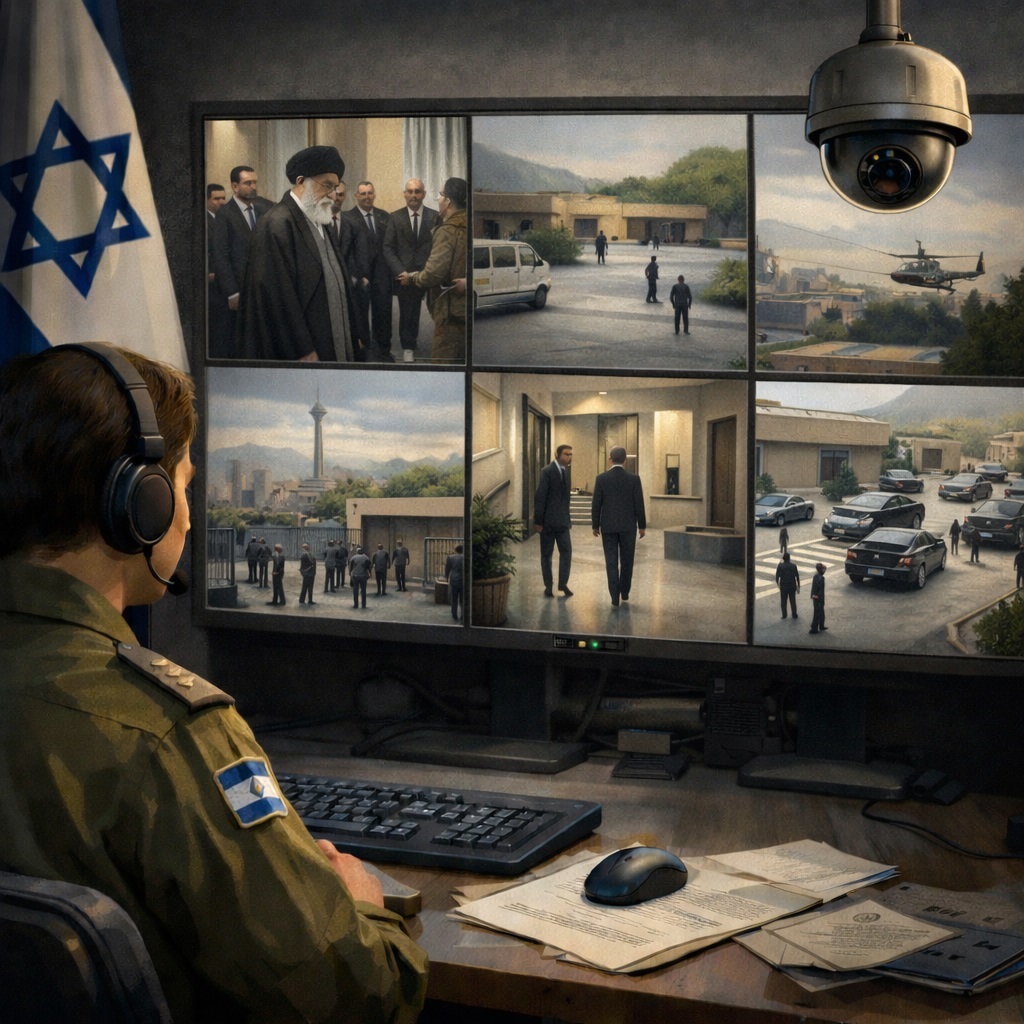
According to the Financial Times, Israeli military and intelligence services gained access to Tehran’s traffic cameras and monitored the operations of the guarded compound where the Ayatollah Khomeini was located for several years.
This was reportedly not a one-off operation but a systematic effort. Sources claim that nearly all traffic cameras in the Iranian capital were compromised. Video feeds were encrypted and transmitted to servers in Tel Aviv and southern Israel. In effect, parts of the city were placed under remote surveillance. If the old saying was “Big Brother is watching,” in this case he was apparently recording too.
The Camera With the Perfect Angle
One particular camera played a key role thanks to its advantageous viewing angle. It allowed observers to monitor vehicle parking and track daily activity inside the heavily protected complex. From such details, intelligence services can build a picture of security routines, movement patterns, and guard habits. In intelligence work, there are no small details, only underestimated ones.
According to the sources, Israeli officials knew Khamenei’s routes and locations long before the attack. One intelligence officer reportedly said that well before the operation, they knew Tehran as well as Jerusalem. It sounds cinematic, but in today’s world, surveillance cameras often become primary sources of strategic intelligence.
Communications Disrupted
In addition, several cellular towers on the street near the residence were reportedly taken offline. This created the appearance of congested lines and prevented Khamenei’s security team from receiving timely warnings about the emerging threat. In high-risk scenarios, even minutes of delay can be decisive.
Events then escalated rapidly. According to reports, Khamenei was killed in his residence on February 28 during the first day of a military operation by Israel and the United States. Several days later, his wife reportedly died from her injuries. Tehran responded with missile and drone strikes targeting U.S. military bases in the Middle East, further increasing regional tensions.
Video Surveillance as a Battlefield
The episode highlights how civilian video surveillance infrastructure can become a powerful intelligence tool. Cameras originally installed for traffic management and public safety can, under certain conditions, turn into sources of national-level intelligence.
Modern cities are covered with thousands of lenses. The key question is no longer whether cameras exist, but who controls access to their streams. Without strong cybersecurity, any surveillance network can become vulnerable. Worse, such breaches can remain undetected for years.
This case is a stark reminder that in the digital age, conflicts are fought not only with missiles and drones, but also with code. And sometimes the decisive asset is not a tank on the street, but a server in a data center hundreds of kilometers away.