
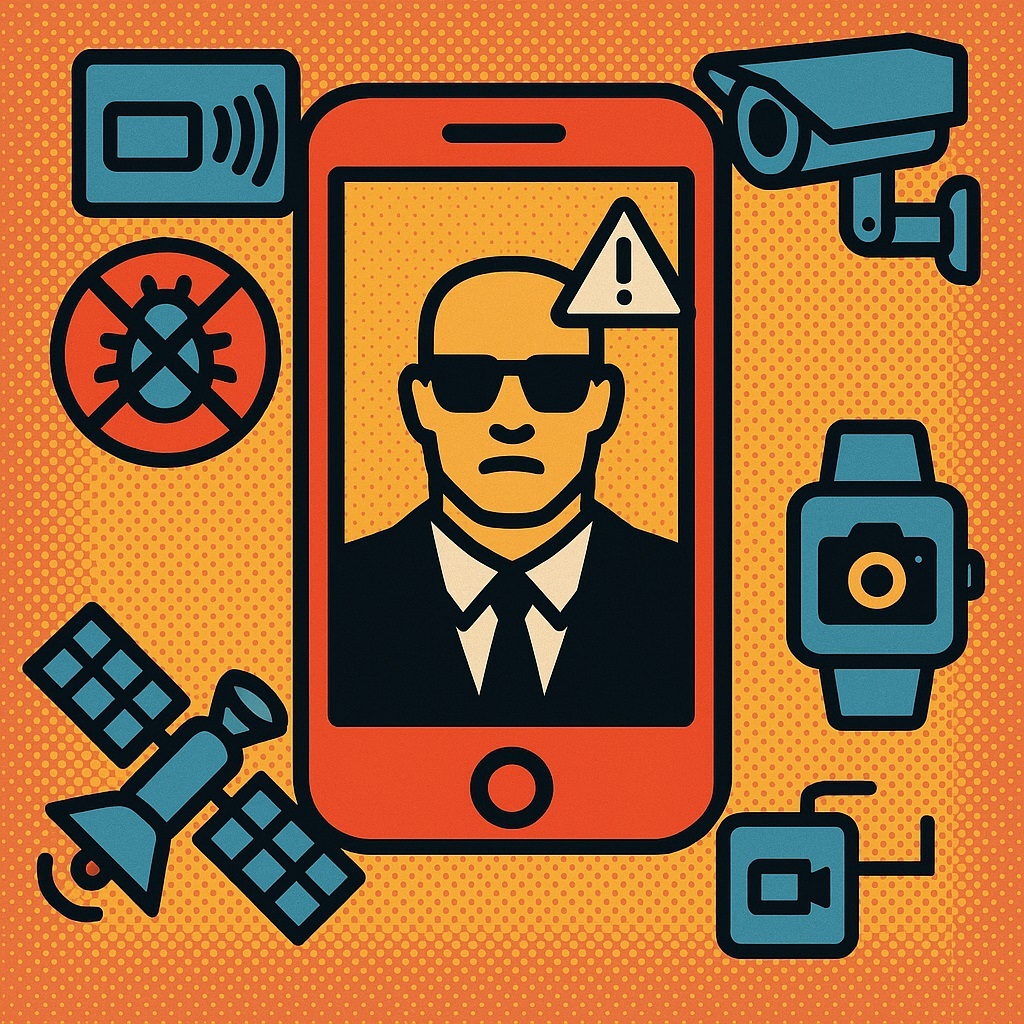
A decade ago, a security officer was the guy in a suit with a walkie-talkie, maybe a badge that read “SECURITY.” Fast forward to 2025, and the real power is hiding in a pocket. Today’s smartphones aren’t just for doomscrolling or watching cat videos — they’ve morphed into full-blown, James Bond–grade security devices.
But here’s the catch: just like a Swiss Army knife, you can save the day with it — or stab yourself in the foot. Let’s take a tour through the most trending (and slightly questionable) ways smartphones are reshaping security work.
1. Hunting for Bugs and Hidden Cameras
Forget lugging around clunky RF scanners. Your smartphone can now double as a spy hunter.
With apps like RTSP Camera, you can even flip the script — turning your old Android phone into a 24/7 IP surveillance cam with professional-level RTSP streaming. Instead of blowing the budget on expensive CCTV, your spare phone becomes both the watcher and the watched. Think of it as “Fight fire with fire,” but with lenses and Wi-Fi.
2. Pocket-Sized Alarm System
Your phone doesn’t just sit quietly; it can bark like a watchdog. Motion alerts, sudden sound detection, even flashing the screen when something moves — all doable.
Enter Motion Detection, the DIY surveillance app. It records video, logs events, and can even upload them to the cloud. Dial up the sensitivity for catching shadows, or unleash neural networks to distinguish between a stray cat and an actual intruder. Fair warning: it’s also great at flagging the janitor’s mop bucket at 2 a.m.
3. Spotting Technical Surveillance
Modern paranoia comes with a side of Bluetooth. Your phone can sniff out Wi-Fi routers, Bluetooth trackers, and other devices that seem to “follow” you across town. If the same MAC address shadows you from Starbucks to your driveway, congrats — you’ve got a digital stalker.
Just don’t mistake your own smartwatch for enemy surveillance. It happens.
4. Pocket Wiretap (with Legal Headaches)
Disclaimer time: eavesdropping is usually illegal. That said, a phone can be turned into a live listening device with the right app.
Take RTSP Camera again — it’s marketed as a way to stream audio and video for legit CCTV setups, but you could just as easily “forget” your phone in the conference room. Technically clever, legally dicey.
5. Remote Photo & Video Capture
Smartwatches already let you snap photos on your phone remotely, but pair them with apps like RTSP Camera and suddenly your old phone moonlights as a covert web camera, streamable to your PC or tablet.
It’s great for DIY security setups — less great when you realize you’ve accidentally filmed yourself binge-eating Doritos at 3 a.m.
6. NFC Shenanigans
Today’s phones can read and clone NFC cards. For security officers, this means setting up patrol routes with NFC checkpoints or issuing virtual access passes.
But the moment you start duplicating your boss’s keycard “for convenience”? Welcome to the wrong side of the law.
7. Remote Access: Ditch the Laptop
Why lug around a 5-pound laptop when your phone can remote into your office systems? With cloud tools like CCTV Cloud, you can get alerts, access live feeds, and manage cameras right from your couch — or your Uber ride.
Of course, skip the VPN and two-factor authentication, and you’ve basically sent hackers an engraved invitation to the party.
Bonus: The “Sensors Off” Button
For the ultra-paranoid, Android hides a “Sensors Off” mode in developer settings. Flip it, and your phone’s mic and camera go dark — like duct-taping the lens, but smarter. Downside? No selfies. Upside? No accidental livestreams of your Zoom face.
Smartphones have evolved into security multitools: bug detectors, alarms, dictaphones, NFC readers, surveillance hubs, even portable CCTV cameras. Apps like RTSP Camera, Motion Detection, and CCTV Cloud push the envelope even further, turning a humble phone into a pocket-sized control room.
But remember: every superpower comes with responsibility. Use these tools wisely, or you risk starring not as the hero of your story, but as the headline of someone else’s newsfeed.