

Over the course of 2025, SmartVision has noticeably shifted away from the image of “just another VMS with analytics” toward a tool designed for long-term operation, scalability, and everyday routine work. The changes are not loud or flashy, but they are systemic. These are technical decisions that may look modest on their own, yet together they significantly simplify life for both engineers and operators.
If this year had to be described in a single phrase, it would be a simple one: less manual work, less unnecessary data, and more control over time, resources, and image quality.
Automatic Camera Discovery via ONVIF
Auto-discovery through ONVIF became broader and more reliable, especially for popular camera models. Wrong profile. Wrong port. Wrong stream path. The less manual input required, the fewer of these classic headaches survive. The system now finds the camera, pulls its parameters, and produces a working result almost immediately.
A Calmer Surveillance Interface
The visual layer grew quieter and more logical. The camera grid changed, because reality refuses to behave like a spreadsheet. Cameras are never identical in the real world, but they almost always exist in groups: corridors, parking lots, perimeters, shop floors.
Previously the ritual was familiar. Add camera, configure stream, choose codec, enable detection, define zones, rules, schedules, events, cloud links. Repeat until tired.
Now a camera can be cloned with every parameter intact. Streams, detectors, rules, schedules, bindings, and the small details people usually remember a week later. Configure a gold-standard camera once, verify it works, then replicate endlessly. Errors rarely come from ignorance. They come from fatigue and repetition.
Video Archive and Disk Quotas
Archive changes were conceptual rather than cosmetic. Recording to multiple disks with clear priority and limits is not just convenience. It protects against typical failures. The system disk no longer quietly dies at night because someone forgot a checkbox. Archives can be distributed across local disks, network storage, and NAS, with predefined capacity limits and usage order.
Most importantly, video is recorded in the open MP4 format. No proprietary file systems and no “native players” that disappear after five years. The disk can be removed, connected to a regular PC, and opened in any standard player. Files are neatly organized by cameras and dates. Events, continuous recording, and timelapse are stored separately. It sounds obvious, but in real life these “obvious” things save archives from oblivion.
There are two recording approaches. Universal and efficient. In the first case everything is converted to H.264, playable anywhere, even in a browser. In the second case the stream is saved as is, including H.265. The CPU rests, the GPU works, and the system calmly handles dozens or hundreds of streams. The compromise is honest. H.265 and browsers are not best friends, but the built-in player handles it perfectly. Need compatibility, choose universal mode. Need performance, choose native stream.
Most importantly, video is recorded in the open MP4 format. No proprietary file systems and no “native players” that disappear after five years. The disk can be removed, connected to a regular PC, and opened in any standard player. Files are neatly organized by cameras and dates. Events, continuous recording, and timelapse are stored separately. It sounds obvious, but in real life these “obvious” things save archives from oblivion.
There are two recording approaches. Universal and efficient. In the first case everything is converted to H.264, playable anywhere, even in a browser. In the second case the stream is saved as is, including H.265. The CPU rests, the GPU works, and the system calmly handles dozens or hundreds of streams. The compromise is honest. H.265 and browsers are not best friends, but the built-in player handles it perfectly. Need compatibility, choose universal mode. Need performance, choose native stream.
PTZ Control Grows Up
PTZ control moved from “it kind of moves” to a real working tool. Cameras react more predictably, commands land more precisely, and preset switching delays shrank. This matters when one camera covers multiple zones and operators must change viewpoints fast.
Automatic IP Camera Updates by MAC Address
DHCP chaos finally met its match. Automatic IP updates by MAC address solve the classic disappearing camera after reboot. The system finds the device by hardware identifier and reconnects it. Yes, some devices manage to change even their MAC address. That is not configuration. That is a personality disorder. Most cameras behave, and the problem disappears without human intervention.
Video Analytics and Motion Detection
Video analytics became quieter and more meaningful. Motion detection algorithms were redesigned to react to real scene changes rather than every shadow or glare. Fewer false events, more trust in notifications.
To reduce load, frames are sent to detectors in stages. A lightweight motion detector triggers first, then frames go to object detection, and finally to advanced detectors such as face recognition or license plate recognition if needed.
License plate recognition moved away from the “one model for the whole world” approach. Different neural networks are used for different regions. The system detects the plate’s country and selects the proper algorithm. Eastern European plates are now handled more accurately, including regional digits with different fonts and layouts. Fine-tuning via configuration files allows balancing speed and accuracy for real projects rather than an abstract “average camera.”
Physics is acknowledged honestly. Recognition depends on camera position, frame rate, lighting, and computer power. The faster the car, the less time the plate stays in frame. Sometimes the human eye sees the plate but the system lacks enough frames for a confident decision. This is solved by configuration or proper camera placement. No miracles here, and that is a good sign.
To reduce load, frames are sent to detectors in stages. A lightweight motion detector triggers first, then frames go to object detection, and finally to advanced detectors such as face recognition or license plate recognition if needed.
License plate recognition moved away from the “one model for the whole world” approach. Different neural networks are used for different regions. The system detects the plate’s country and selects the proper algorithm. Eastern European plates are now handled more accurately, including regional digits with different fonts and layouts. Fine-tuning via configuration files allows balancing speed and accuracy for real projects rather than an abstract “average camera.”
Physics is acknowledged honestly. Recognition depends on camera position, frame rate, lighting, and computer power. The faster the car, the less time the plate stays in frame. Sometimes the human eye sees the plate but the system lacks enough frames for a confident decision. This is solved by configuration or proper camera placement. No miracles here, and that is a good sign.
Smoke and Fire Detection
Smoke and fire detection arrived as an extra layer, not a replacement for fire alarms. Cameras see scene changes before ceiling sensors smell smoke. Warehouses, parking garages, open areas, industrial sites benefit the most. The module resists fog, steam, and glare by analyzing behavior, not color blobs.
Timelapse
Timelapse quietly became a powerful tool. One frame per second or minute preserves history without massive archives. The system automatically switches to full recording when activity appears, then returns to timelapse mode. Construction, industry, remote sites, city monitoring. Timelapse turns into reporting, analytics, and the ability to see slow processes the human eye ignores.
SmartVision: What Comes Next
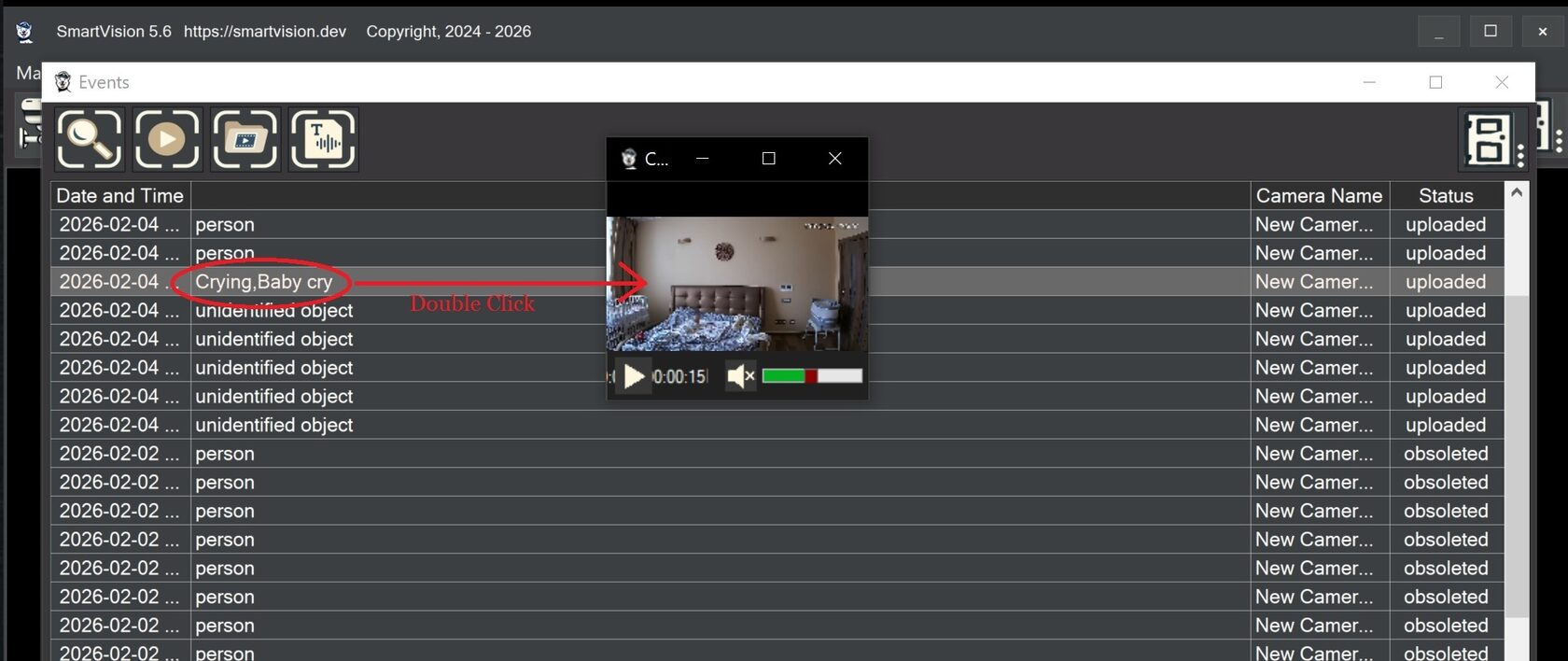
In 2026, full-fledged neural network–based sound detection has already been implemented without unnecessary CPU load. The system continuously analyzes the audio stream and identifies one of 500 configurable sound types. Event recording can be triggered even when there is no motion or objects in the frame. Use cases are wide-ranging: a baby crying or screaming, monitoring a patient’s condition, observing animals, or detecting emergency and abnormal sounds in industrial environments
Instant Notifications
A module for fast, near-instant notifications with event photos is being prepared for Telegram and other messengers. It will be possible to select specific events that require notifications, such as a baby crying.
External Integrations
A configuration module for integration with external systems is under development. This includes access control systems, barriers, and smart home devices. The module will allow creating actions for specific events using arbitrary POST and GET requests. As a result, certain events will be able to trigger door opening, barrier control, lighting on or off, or interaction with virtually any external device.