
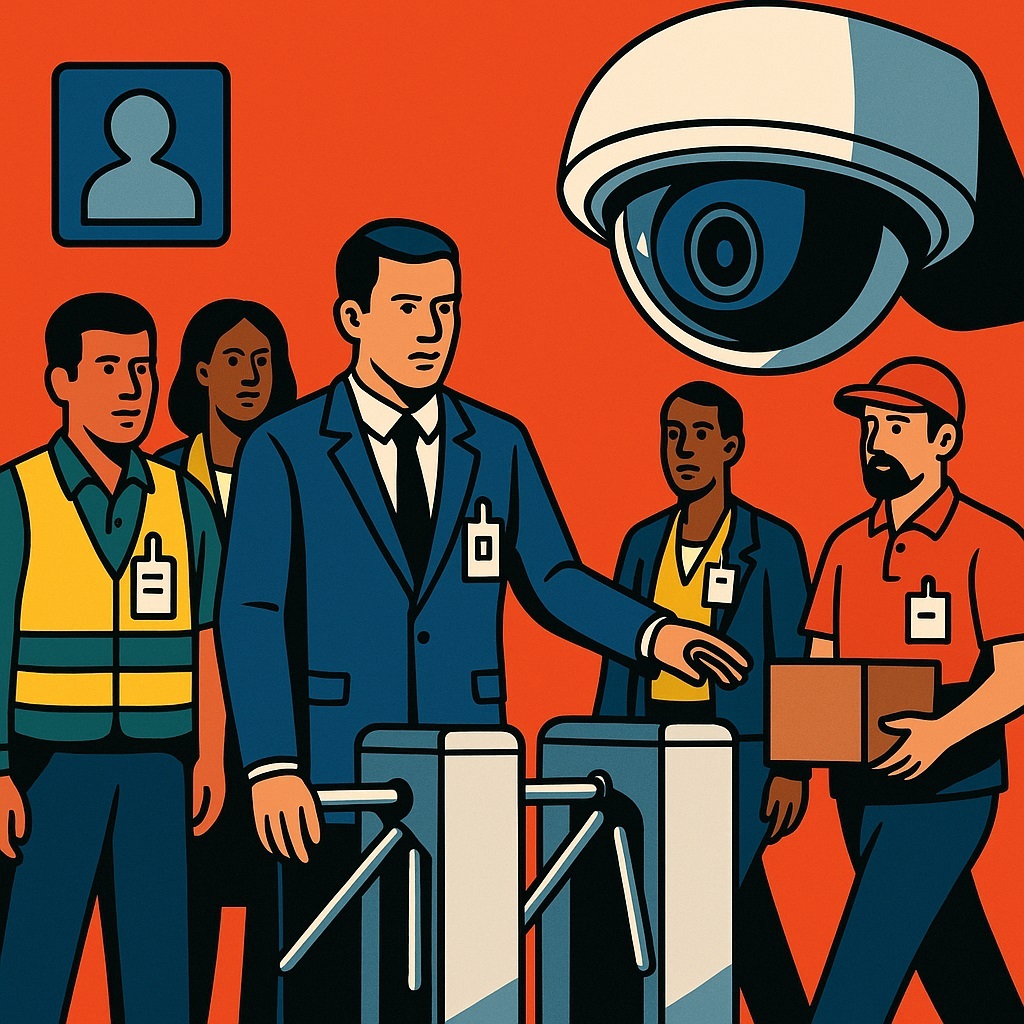
Imagine an office lobby. Not the glossy Googleplex atrium with living walls and kombucha on tap — I mean a regular office: gray carpet, a flickering coffee machine, and a front desk staffed by a retiree who knows everyone by name. There, security is easy: “You’re from accounting? Go ahead. Don’t recognize you? Stop right there.”
Now scale that to the real world: airports, data centers, power plants. Suddenly, your “retiree with a clipboard” is laughably outgunned. That’s where modern Access Control Systems (ACS) step in — digital gatekeepers armed with turnstiles, biometrics, cloud integration, and, increasingly, AI.
What Access Control Really Means
Strip away the jargon, and ACS does one thing: let the right people in, and keep the wrong people out.
Sounds simple, right? Except “visitors” come in every flavor:
- A contractor fixing the HVAC for three hours (or three days).
- An auditor camping in your office for a month.
- A courier with pizzas.
- A family member dropping by “for five minutes.”
Each one needs a different level of access, for a different amount of time, and each one is a potential headache for security staff.
Why “Visitor” Is the Scariest Word in Security
A recent study asked security pros what they’d most like to change about their systems. After the obvious “access” and “control,” the third most common word was “visitor.” Translation: they hate this part.
Why?
- Paper logbooks are prehistoric.
- Excel spreadsheets are just paper pretending to be digital.
- Visitor policies are either too soft (“just scribble your name”) or draconian (“submit a full dossier before your FedEx guy can enter”).
The result: chaos. Either you lock everything down like Fort Knox or shrug and let everyone through. Neither is sustainable.
Policies, Badges, and Color-Coded Cosplay
Most companies stick to the basics: show ID, wear a badge, display it clearly. In industrial facilities, they take it further with reflective safety vests in different colors. It’s basically an MMORPG of access control: red vest = contractor, yellow = auditor, green = family. One look across the shop floor tells you exactly who doesn’t belong — and that cosplay can literally save lives.
Digital vs. Paper: Hogwarts vs. Clipboards
The biggest mistake? Tracking visitors manually. The second-biggest? Thinking Excel is good enough.
Modern visitor management systems do much more:
- Generate visitor passes from Outlook meeting invites.
- Sync with turnstiles and cameras.
- Keep real-time logs in the cloud.
It’s corporate Hogwarts, minus the magic wand.
Effectiveness: Numbers Don’t Lie
Here’s the upside: ACS actually works. Big companies report very few incidents. And confidence skyrockets when systems can track not just employees, but everyone entering and leaving. Security pros who had full tracking were 73% confident in their systems, versus just 45% where visitors slipped through the cracks.
The Achilles’ Heel: Humans
All the biometrics and AI in the world won’t save you if the guard waves in “a buddy” without checking. Or if employees treat badges as car mirror decorations.
The truth? Access control isn’t just hardware and software — it’s culture. If people don’t buy into the “why” behind security, they’ll find ways around it. And when they do, even the smartest system collapses.
Access control today isn’t about locks and keys. It’s about managing chaos with algorithms, cameras, and digital logs. It decides who gets through the door: contractor, auditor, or that pizza guy.
And if your building still relies on a paper sign-in sheet? Congratulations, you’re stuck in the 19th century. The pizza’s probably already inside.