
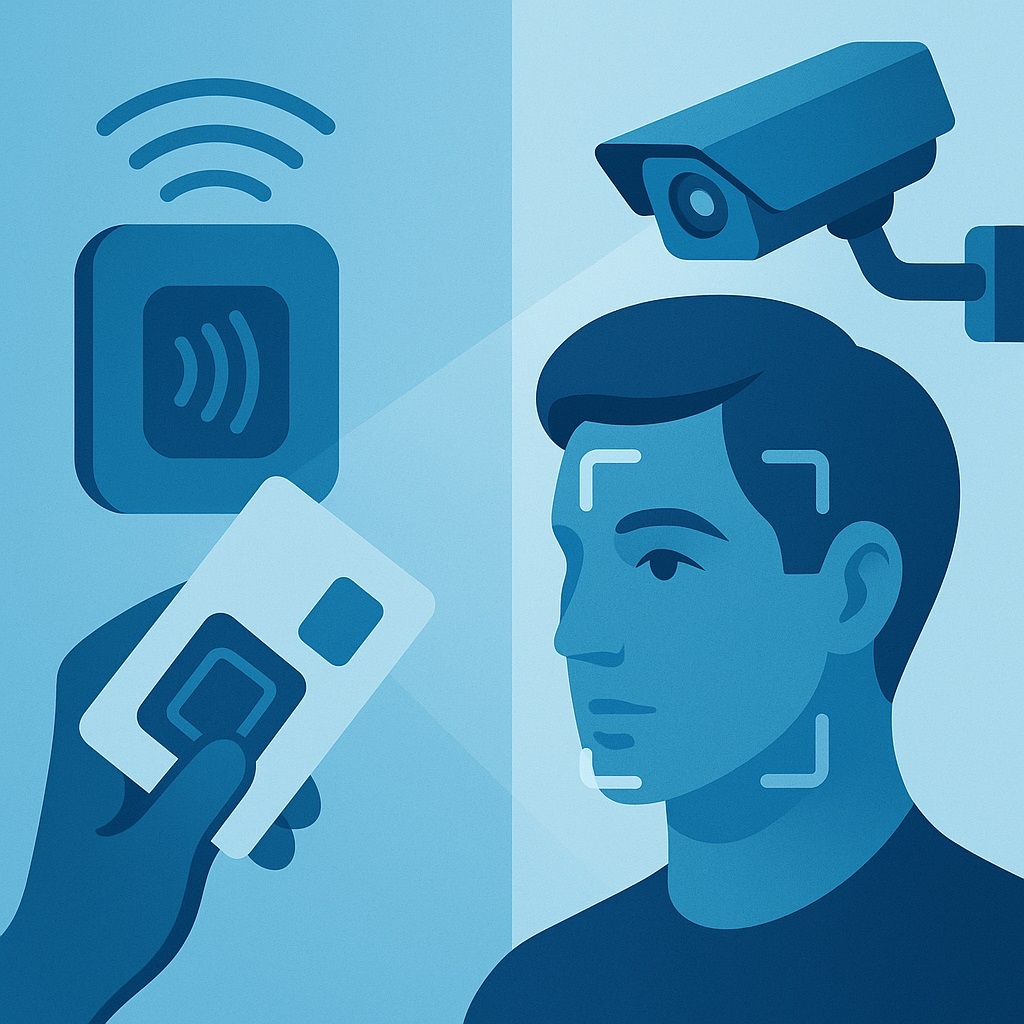
Replacing Access Cards with Face and Voice: Where the Market Is Heading
Once upon a time, access control meant plastic badges, magnetic fobs, and turnstiles blinking green. That era is fading fast. The next generation of security systems recognizes an employee by face, voice, or even gait — and not through costly proprietary devices, but through standard IP cameras powered by AI analytics.
The access control market is evolving toward biometrics, while lawmakers worldwide are racing to establish clear privacy and compliance frameworks.
From RFID to Biometrics: The End of the Card Era
RFID (radio-frequency identification) technologies dominated access control for decades.
Advantages of RFID:
- Low installation cost
- Simple integration with existing systems
- Reliable even with limited network connectivity
Disadvantages:
- Easily cloned, especially older LF cards
- Cards can be lost, shared, or stolen
- Requires physical proximity — inefficient for large flows
- No real identity verification: a card is not a person
That last point — the gap between possession and identity — has become the main reason many enterprises are transitioning to biometric access.
Camera Instead of Card: The Rise of AI-Driven Biometrics
Modern IP cameras with built-in neural analytics can identify faces, voices, or behavioral patterns without separate biometric terminals. For many businesses, this means they can deploy biometric access using the infrastructure they already have.
Common scenarios include:
- Facial recognition at entry points using regular cameras
- Voice verification through intercoms
- Dual authentication (face + card) for critical zones
- Attendance and time tracking without physical turnstiles
Benefits of biometric ACS:
- Non-transferable credentials — you can’t lend your face
- Fully contactless — ideal for healthcare and clean industrial sites
- Unified digital identity for all internal services — office, cafeteria, parking
- Integration with video analytics for richer context and security logs
- Lower operational costs — no cards to print, issue, or replace
Challenges and risks:
- Strict data privacy and security compliance
- Sensitivity to lighting, camera angle, masks, and glasses
- Network and server dependency for real-time recognition
- Public trust and data-transparency concerns
Still, biometrics now surpasses RFID in nearly every practical metric: convenience, traceability, and security.
Global and U.S. Regulatory Environment: Toward Responsible Biometrics
While global adoption accelerates, regulation is catching up. Different regions are establishing their own frameworks to balance innovation, privacy, and accountability.
United States
The U.S. does not yet have a single federal biometric privacy law. Instead, oversight falls under the Federal Trade Commission (FTC) and a patchwork of state-level laws:
- Illinois’ Biometric Information Privacy Act (BIPA) — requires informed written consent, retention policies, and allows private lawsuits for violations.
- Texas and Washington — mandate notice and consent before biometric collection.
- California Consumer Privacy Act (CCPA) — treats biometric data as a sensitive category, requiring disclosure, opt-out rights, and reasonable data protection.
- Over twenty U.S. states are drafting or expanding similar privacy laws regulating biometrics and AI analytics.
International Context
- GDPR (European Union): Treats biometric data as “special category” data; collection requires explicit consent, limited retention, and transparency.
- UK Data Protection Act (UK GDPR): Mirrors EU principles, with additional guidance for workplace monitoring.
- Canada’s PIPEDA and Australia’s Privacy Act: Require organizations to justify biometric use as necessary and proportional, ensuring storage on secure servers.
- ISO/IEC 24745 and NIST SP 800-63-3: Define international best practices for biometric data protection, encryption, and identity assurance levels.
Across markets, the trend is clear: biometric systems must prioritize transparency, consent, and data minimization, supported by clear security standards and auditability.
Legal and Compliance Obligations for Enterprises
When deploying biometric access systems, organizations must:
- Obtain explicit, informed consent from users before capturing biometric identifiers.
- Disclose purpose, retention period, and deletion policies in clear language.
- Encrypt biometric templates both in transit and at rest.
- Restrict data use strictly to access and security functions.
- Provide opt-out or alternative authentication where required by law.
- Audit and document system activity to demonstrate compliance.
Non-compliance in some U.S. jurisdictions can result in class-action lawsuits or regulatory fines reaching millions of dollars.
Implementation in Practice: From Theory to the Door
Businesses generally choose one of three migration models:
Hybrid Access (Card + Biometrics)
RFID and biometric verification are combined; one factor confirms the other. Useful for gradual rollout and user adaptation.
Full Biometric Access
Cameras identify employees in real time; entry is fully automated without cards or keypads.
Cloud or Hybrid Biometric Services
Recognition data processed via secure cloud servers. Suitable for distributed companies and multi-site enterprises.
With AI-based software modules, even existing IP cameras can deliver biometric accuracy that once required expensive terminals — cutting deployment costs several times over.
Technology Comparison
Criterion RFID Biometrics (Face/Voice via IP Cameras)
Public Perception and Market Confidence
Public sentiment toward biometrics is gradually improving worldwide. In surveys across the U.S., U.K., and EU, more than half of respondents say they are comfortable with biometric authentication if data is properly protected and not used for unrelated purposes.
Transparency — explaining how and why data is used — remains the strongest driver of trust. Companies that clearly communicate policies and security practices see higher user acceptance and fewer privacy complaints.
Market Outlook: The Road Ahead
By 2026, biometric access control is expected to become a mainstream security standard in corporate offices, hospitals, logistics centers, and smart buildings.
Key trends shaping the next few years:
- Camera-based AI analytics replacing dedicated terminals
- Cloud and edge computing enabling faster recognition and easier scaling
- Unified identity ecosystems linking building access, parking, and workstation login
- Privacy-by-design architectures becoming a compliance must-have
- Cross-platform standards (ISO, NIST, ANSI) driving interoperability between systems
The shift from cards to faces and voices is not just technological—it’s philosophical. Access control is evolving from “Who holds the key?” to “Who truly is the person?”
RFID won’t disappear overnight, especially in budget-conscious environments, but the future of secure access clearly belongs to biometrics — where the door opens not to what you carry, but to who you are.