
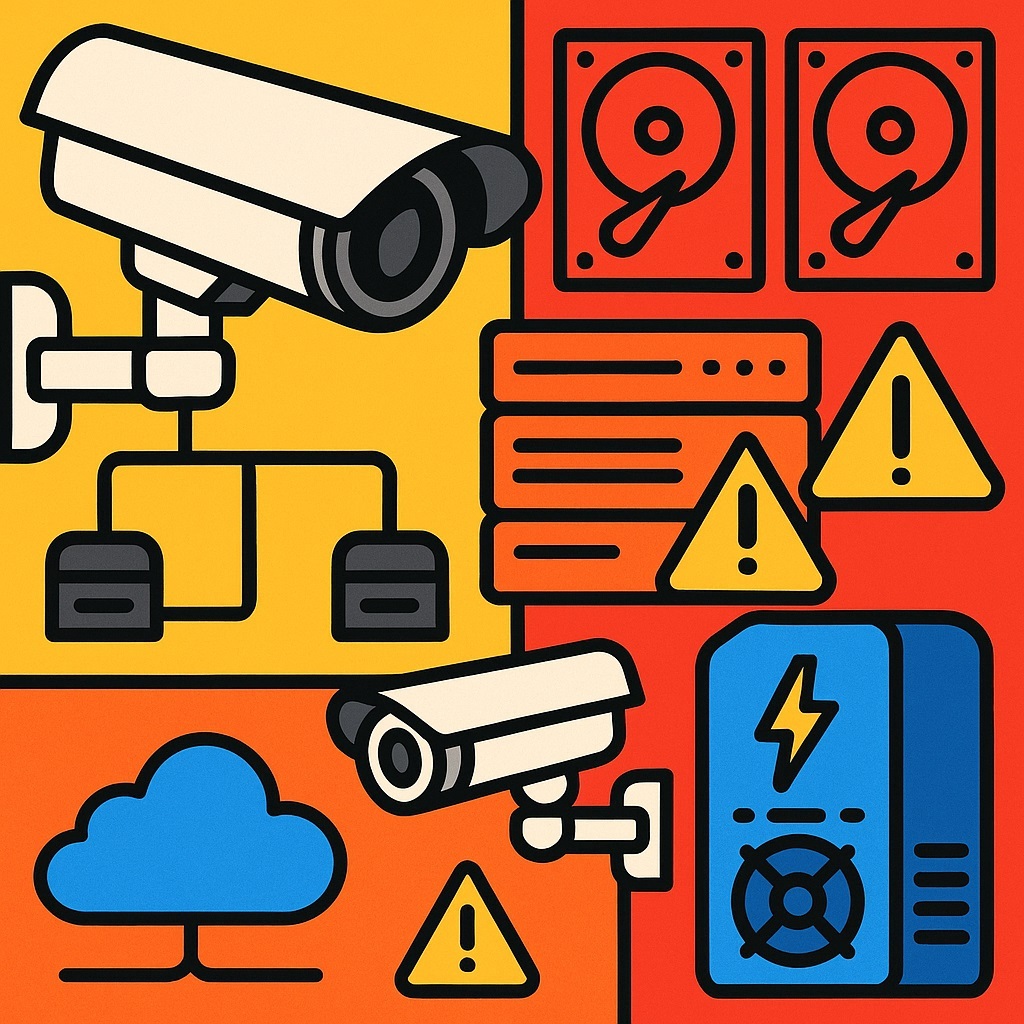
You can deploy a thousand cameras sharp enough to spot a zit on a suspect’s face from half a mile away. But if your server decides to take a coffee break, congratulations — you’ve just built a very expensive collection of “No Signal” screens. In today’s world, where businesses measure themselves not just in revenue but in megapixels of archived footage, surveillance reliability isn’t a luxury. It’s survival.
Welcome to the universe where a single dead hard drive isn’t just an IT hiccup — it’s the moment a thief walks free.
Server Layer: The Hot–Cold Drama
The workhorse of surveillance setups is the NVR — a kind of digital VCR on steroids. For small businesses, it’s a trusty Nokia 3310: simple, sturdy, but dangerously single-point-of-failure. When it dies, it dies big.
Enter failover. One NVR records, while another waits in the wings like an understudy in a Broadway show. When the star collapses, the backup jumps in. Great in theory, but the archive on the dead box? It may be gone forever. Cue awkward silence in court.
The IT crowd prefers virtualization. Here, cameras write into a flexible ecosystem where workloads migrate from one server to another faster than an IT guy dodging a budget meeting. Hyperconverged infrastructure (HCI) cranks it up even more: every server shares storage, so if one explodes, the rest barely notice. The footage keeps flowing, and the past remains instantly accessible.
Storage Layer: RAID Is Just the Opening Act
Disks fail. That’s why RAID exists — a juggling act with spares. One disk drops, the show continues. But that’s the kiddie pool.
HCI makes RAID look like amateur hour, spreading video across every drive in every server. Lose a server, lose nothing. For the paranoid, there’s dual-stream recording: cameras write to two completely separate archives. One burns down? The other’s ready for prime time.
Infrastructure: When the Lights Go Out and the UPS Smokes
Even the best setup is worthless if the lights go out. That’s why serious outfits build redundant networks, duplicate switches, and deploy cameras with local SD storage. When the internet dies, the cameras just shrug and keep recording to their cards until the grid comes back.
Then there’s the hardware zoo: redundant fans, power supplies, NICs. Add UPS systems, backup generators, and cloud copies, and you’ve got a fortress where footage survives everything short of an asteroid strike.
The Three Laws of Surveillance Survival
- Never trust a single server. It will betray you.
- Spread your footage far and wide. Local, cloud, off-site — redundancy is life.
- Plan for the apocalypse. Only layered resilience saves you when the dominoes start falling.
Surveillance systems aren’t just about cameras that watch — they’re about ecosystems that never blink. The question isn’t if something will fail. It’s when. If your security strategy ends with “hopefully nothing breaks,” you’re not running a system. You’re playing Russian roulette with hard drives.
In a world where courts demand evidence and customers demand accountability, there’s only one right answer: unapologetically overbuilt, multilayered, Wired-grade resilience.